AMIA bombing: Why Argentina is charging Iran and Hezbollah suspects 32 years later
A new Argentine indictment names seven Iranian officials and a Hezbollah operative accused of roles in the 1994 attack on Buenos Aires’ Jewish community center

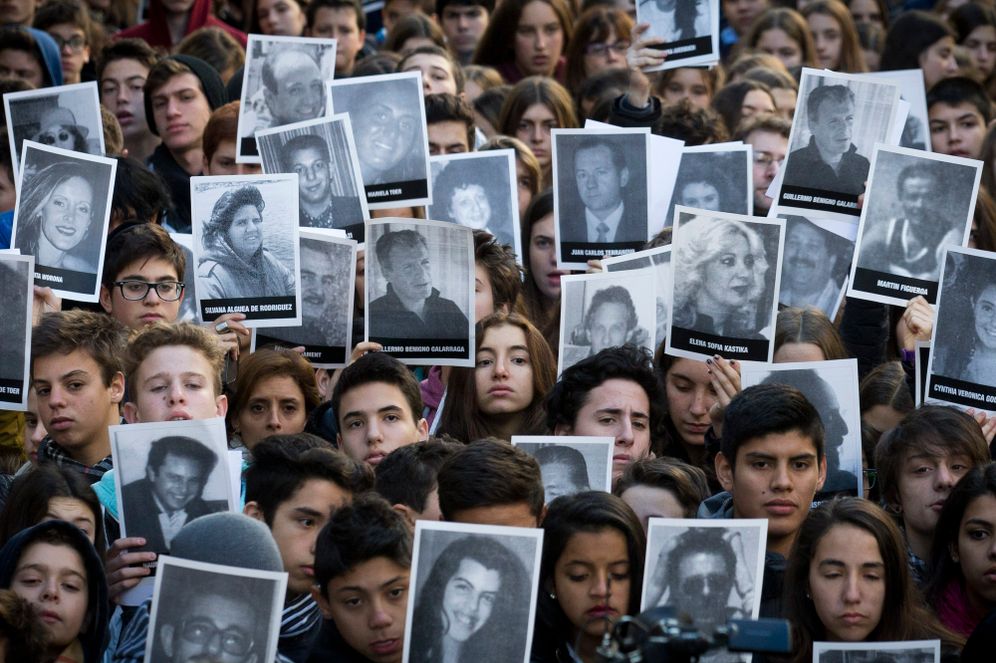
More than three decades after a bombing destroyed Argentina’s Jewish community center and killed 85 people, an Argentine judge has formally charged seven Iranians and a Lebanese national over their alleged roles in the attack.
The decision on Monday brings the country one step closer to a potential trial in absentia in one of the world’s longest-running terrorism investigations.
But what happened at the AMIA Jewish community center, who does Argentina hold responsible, and why has it taken 32 years for the case to reach this point?
Argentina’s Jewish community
Argentina is home to Latin America’s largest Jewish community, with an estimated 170,000 to 180,000 Jews, most of them living in Buenos Aires. The community has roots in waves of Jewish immigration from Europe, as well as longstanding Sephardic communities from the Middle East and Mediterranean.
Over generations, Argentine Jews built a strong network of synagogues, schools and community organizations. AMIA was one of its central institutions, making the 1994 bombing not only a mass-casualty attack, but a devastating strike at the heart of Jewish life in Argentina.
What happened in the AMIA bombing?
On July 18, 1994, a suicide bomber drove a van packed with explosives into the Argentine Israelite Mutual Association, known by its Spanish acronym AMIA, in Buenos Aires.
The blast killed 85 people and injured 151, destroying much of the seven-story Jewish community center.
The attack was the deadliest antisemitic attack outside Israel since the Holocaust.
It came just two years after another major bombing in Buenos Aires: the 1992 attack on the Israeli Embassy, which killed 29 people.
No one has ever been convicted of carrying out the AMIA bombing.
Who does Argentina say was behind the attack?
Argentina has long accused Iran and Hezbollah of orchestrating the bombing.
According to Argentine prosecutors and courts, the decision to attack AMIA was made by senior Iranian officials and was then carried out by Hezbollah, Iran’s Lebanese proxy group.
In 2024, an Argentine court formally ruled that Iran and Hezbollah were responsible for the attack.
Judge Daniel Rafecas’s latest ruling says the decision to attack AMIA was made in August 1993 by the highest levels of the Iranian regime and entrusted to Hezbollah. The group then allegedly organized a regional and local support network to prepare and carry out the bombing.
Iran has denied responsibility for the bombing.
How was the attack carried out?
According to Rafecas’s reconstruction, the attackers purchased a Renault Trafic van on July 10, 1994, just eight days before the bombing.
The vehicle was then modified and loaded with approximately 300 kilograms of ammonal and TNT.
The van was eventually driven onto the sidewalk outside the AMIA building and detonated, causing the massive explosion that killed 85 people and injured 151.
Who has now been charged?
Monday’s decision formally charged seven Iranian nationals and one Lebanese national, all of whom are outside Argentina and could face trial in absentia.
Judge Daniel Rafecas divided the defendants according to their alleged roles in the attack.
Four senior Iranian officials were charged as “indirect authors” of the bombing: Ali Fallahijan, who was Iran’s intelligence minister at the time; Ali Velayati, then foreign minister; Mohsen Rezai, then commander of Iran’s Revolutionary Guard; and Ahmad Vahidi, who commanded the Quds Force.
Rafecas also charged three other Iranian nationals as necessary accomplices: Hadi Soleimanpour, Iran’s ambassador to Argentina at the time; Mohsen Rabbani, the Iranian Embassy’s cultural attaché; and Ahmad Asghari, identified in the ruling as a Revolutionary Guard intelligence agent.
The eighth defendant is Salman Raouf Salman, also known as “Samuel El Reda,” a Lebanese Hezbollah operative whom Rafecas says coordinated the final stages of the attack.
The eight charged suspects are not in Argentine custody.
Why is there a trial in absentia?
The AMIA investigation has faced a fundamental problem for decades: the people Argentina accuses of organizing the attack have remained outside the country.
In June, Rafecas ruled that the Iranian and Lebanese suspects could be tried in absentia.
Argentina introduced a legal framework for trials in absentia in 2025. Under the system, defendants accused of certain serious crimes can be tried without being physically present, provided their rights to a defense and other due-process guarantees are protected.
The decision does not mean a trial will begin immediately.
The indictments can still be appealed, and additional procedural steps must be completed before a trial can move forward.
Why has the investigation taken so long?
The AMIA case has been plagued by allegations of political interference, corruption and obstruction of justice.
In 2004, prosecutor Alberto Nisman was appointed to investigate the bombing. He spent years building a case that Iran and Hezbollah were responsible.
But in January 2015, Nisman was found dead in his Buenos Aires apartment, just hours before he was due to present allegations that then-President Cristina Fernández de Kirchner and other senior officials had participated in an alleged cover-up of Iran’s role in the AMIA attack.
His death was initially ruled a suicide.
Argentine authorities later determined that Nisman had been murdered.
His death became another major controversy surrounding an investigation that had already deeply divided Argentine politics and society.
What happened to officials accused of obstructing the investigation?
The AMIA case has also led to criminal proceedings against Argentine officials accused of interfering with the investigation.
Former President Carlos Menem, who was in office during both the 1992 Israeli Embassy bombing and the 1994 AMIA attack, was tried over allegations that he helped cover up aspects of the investigation. He was ultimately acquitted and died in 2021.
Former intelligence chief Hugo Anzorreguy was sentenced to four and a half years in prison for obstructing the investigation.
Former AMIA investigating judge Juan José Galeano was also convicted. In 2019, he was sentenced to six years in prison for concealing evidence and violating his duties.
In 2024, the Inter-American Court of Human Rights also held the Argentine state responsible for failing in its duty to properly investigate the AMIA bombing.
Could the AMIA and Israeli Embassy bombings be connected?
Monday’s ruling also raised the possibility of formally connecting the two Buenos Aires attacks.
The Israeli Embassy bombing in March 1992 killed 29 people, while the AMIA attack two years later killed 85.
Both attacks have been linked by Argentine investigators to Hezbollah and Iran.
Rafecas has asked Argentina’s Supreme Court to weigh in on whether the two cases should be connected, potentially allowing investigators to examine the attacks as part of a broader campaign. (infobae)
What does this mean for Argentina’s Jewish community?
The AMIA bombing remains one of the defining tragedies in the history of Argentina’s Jewish community.
For decades, relatives of the victims have demanded accountability, while successive Argentine governments and courts have struggled to bring those accused of orchestrating the attack before a courtroom.
Monday’s indictment does not resolve the case.
But it represents a significant new legal step toward a trial, potentially one that could take place even if the accused never appear in Argentina.
President Javier Milei, a strong supporter of Israel who has made the AMIA investigation a prominent issue, welcomed the decision.
“Morality as state policy,” Milei wrote on X.
For the families of the 85 people killed in 1994, however, the central question remains the same: after more than three decades, will anyone ultimately be held accountable for the attack?