How West German Intelligence manipulated the Eichmann Trial
West German Intelligence not only controlled Eichmann's defense strategy but also fed information to reporters and journalists portraying him as 'shockingly normal'

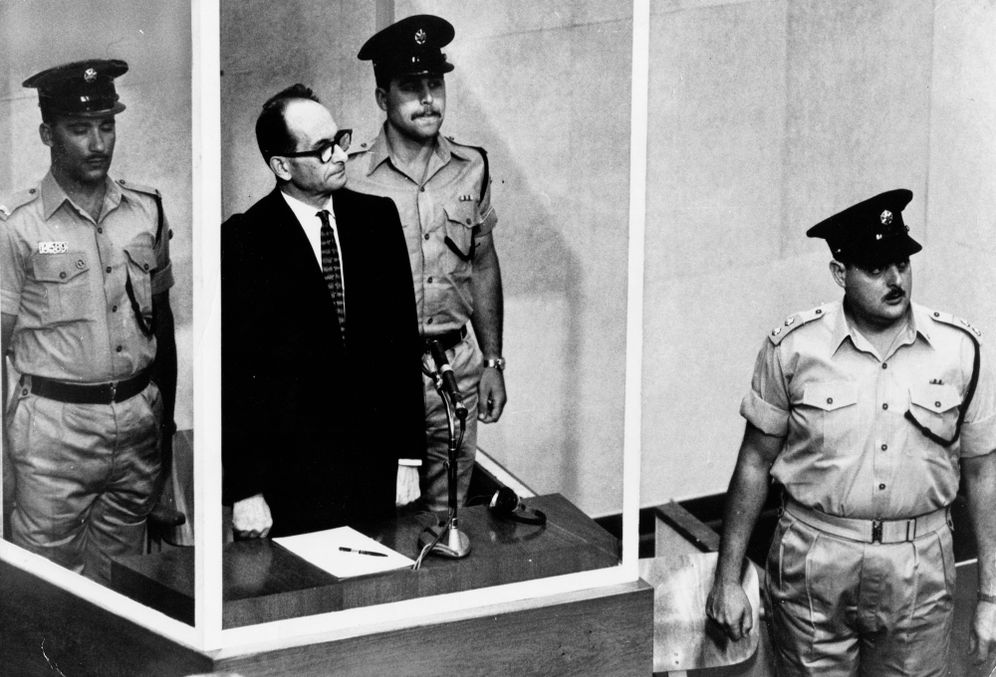
Last Friday the Süddeutsche Zeitung published one of the most extensive and in-depth investigations in to the influence the West German government had on the trial of Adolf Eichmann.
Not only did German intelligence control Eichmann's legal team and therefore his defense strategy, in clear violation of the rights his lawyers were supposed to uphold, they also fed information to Hannah Arendt and others writing about the trial to influence their views on Eichmann. Many of the views would become central to Arendt's thesis in the "Banality of Evil."
The investigation revealed that almost all aspects of Eichmann's defence were in fact guided by the newly created Federal Intelligence Service (Bundesnachrichtendienst/BND). Eichmann's defence was carefully calibrated to protect high-ranking members of the West German Adenauer government who had played key roles in the Holocaust.
"This disclosure also makes it clear just how weak the West German government’s commitment to the rule of law was and how unsuccessful it had been in truly exorcising the National Socialist mentality," Willi Winkler, the report's author, writes.
Denazification is often touted as one of the major successes of the defeat of Nazi Germany, but it seems that, at least when it came to politics and intelligence, Germany was anything but denazified.
Chancellor Konrad Adenauer tasked Reinhard Gehlen with oversee the BND as its first director. Gehlen was a senior member of Wehrmacht intelligence during the Second World War and was only dismissed at the end of the war for "defeatism." Despite his Nazi past, Gehlen became central to anti-Soviet intelligence operations for the predecessor organizations of the CIA.
The man Adenauer worked so hard to protect was his chief of staff, Hans Globke. Globke had served as Adenauer's Chief of Staff since 1953, but his past connections to the Nazi regime were deep.
Globke's most significant contribution to Nazi Germany was as the legal theorist who laid the legal groundwork for the implementation of the Nuremberg Laws. Although he was denied Nazi Party membership in 1940, he remained a key jurist for the duration of the regime.
Adenauer seems to have selected Globke exactly because of his past, with Globke's past giving Adenauer leverage over him. This was a familiar tactic for Adenauer who had five former Nazis Party members in his cabinet.
Indeed, Globke may have even been seen as a better choice as he had been cleared to work for the American occupation, although this was due to his friendship with Jewish American lawyer Robert Kempner, who served as deputy chief American prosecutor at the first Nuremberg trial.
Israel also had good reason to protect Globke; he was seen as "a guilty conscience" who would be keen to help Israel. For example, Globke was one of the key architects behind German reparations to the Jewish people, with even Ben-Gurion arguing in his favour, saying "Globke acted correctly. Even though he wrote the commentary to the Nuremberg Laws."
Globke's contribution seems to have been kept under wraps and out of the spotlight. He portrayed himself as just another bureaucrat swept up in Nazi chaos, known as a "fellow traveller."
Winkler writes, "It was in Bonn’s interest that responsibility for the Holocaust, with all its suffering and cruelty, remain concentrated on the single defendant Eichmann – and not be extended to the hundreds of thousands of accomplices, collaborators and fellow travellers, more than a few of whom continued their careers in the postwar period and in some cases rose to the highest positions."
Globke was also well-respected by Gehlen. Gehlen was initially skeptical about the prospect of an intelligence service under democratic governance, but warmed to the idea under Globke. Adenauer believed that Gehlen "understands something about how things were done in earlier times."
It appears that the modus operandi of the old days remained in play well into the 1960s. Under Gehlen, the BND continued to refer to perceived opponents in the language of the Nuremberg Laws such as "half-Jews" and "quarter-Jews." This should not be surprising since large numbers of former SS intelligence agents had been recruited into the BND as Winkler says, "National Socialist sentiment had by no means been overcome."
Indeed, documents showed that the BND had been aware of Eichmann's location since 1952 and had neglected to act. German historian Bettina Stangneth told Der Spiegel in 2011 that it would have been nearly impossible for West Germany to put Eichmann on trial at the time, not least due to the fear that he would identify other key members of the regime still in power in West Germany.
All this meant that when Eichmann was captured, the West German government feared that he would point the finger at the more senior figure of Globke, leading the BND to tap their newly recruited lawyer Dieter Wechtenbruch, also known as Agent V-7461, "Laqueur." He was quickly embedded within Eichmann's defence team led by Robert Servatius.
From the summer of 1960 onward Wechtenbruch fed the BND all the details of the trial. "By any legal standard, this was a flagrant betrayal of the client’s interests," Winkler writes, which makes the entire situation darkly ironic. Eichmann had specifically been given a German defence team to ensure the fairness and legal soundness of his trial, but as it turned out his legal team was there to ensure he wouldn't name names and point fingers.
Initially, however it seems that the BND's effort was superfluous as Eichmann seemed to have never even heard of Globke. Israeli intelligence also missed the agent in their midst, as Wechtenbruch was interviewed by an Israeli agent named "Almog" who cleared him.
The BND requested that Wechtenbruch not influence the case, but the young agent went off script and began briefing reporters and journalists on the case while offering his own assessments. This included Hannah Arendt who used Wechtenbruch's assessment of Eichmann to draw the conclusion that Eichmann "is an insignificant person." Winkler even attributes the original term "Würstchen" to Wechtenbruch, which seems to have been an attempt to play down the significance of Eichmann.
Arendt didn't seem to notice that much of her information was being carefully controlled by the very man trusted to relay it. Wechtenbruch seems to have even propagated the idea that Eichmann was "shockingly normal" and that others in his position would have acted similarly. Within the context of the BND's operation this position seems suspect, but when factoring in the immense involvement of former Nazis in the operation, the characterization of Eichmann as "shockingly normal" seems to be little more than a ploy designed to ameliorate the evil present in the Nazi bureaucracy.
Toward the end of the trial Eichmann began reading vociferously about the Holocaust and suddenly began wanting to name Globke and other responsible officials. He discovered that not only had Globke been responsible for helping legalize the Nuremberg laws and using them as the basis of the Holocaust, but that he had been responsible for a 1932 memo within the Prussian Interior Ministry aimed at preventing "name changes that obscured descent by blood."
Eichmann asked the Globke be summoned as a witness to testify to the fact that Eichmann had only been a "small cog in the machine." Globke had been a significantly more senior figure and had been far more intimately involved in pre-planning the Holocaust, but this was blocked by the BND and Ben-Gurion who instructed prosecutor Gideon Hausner not to mention Globke, telling him that there were political reasons for protecting Globke.
In the end, the BND's cover-up worked and few people were even aware that the cover up had occurred. Winkler notes that outside of those involved in the operation and a few high-ranking members of the government, nobody else discovered what they had done. A CIA report into Wechtenbruch's handler Hans Rechenberg showed that even they had no knowledge of the operation. Globke was also kept in the dark as he requested information on Wechtenbruch long after Wechtenbruch had already been assigned to the case.
For his part Ben-Gurion seems to have been serendipitously involved in the cover up through his own interests in thawing relations with West Germany. Not only did he act to preserve the new diplomatic relations with West Germany, but he also directly removed all references to Globke from the appeals process.
Globke died in 1973, with no charges being brought against him. Wechtenbruch died in 2025 having never spoken about his involvement with the BND.
These revelations cast a serious shadow over the trial of Eichmann. There can be no doubt as to Eichmann's guilt, but whether he received a fair trial is now in question.