'Too small for the future' defense establishment demands expansion of Israel Navy, as sixth submarine arrives from Germany
There is growing concerne from security officials because despite the arrival of the INS Drakon from Germany, Israel has only 6 submarines, while Turkey has 12 and Greece has 9

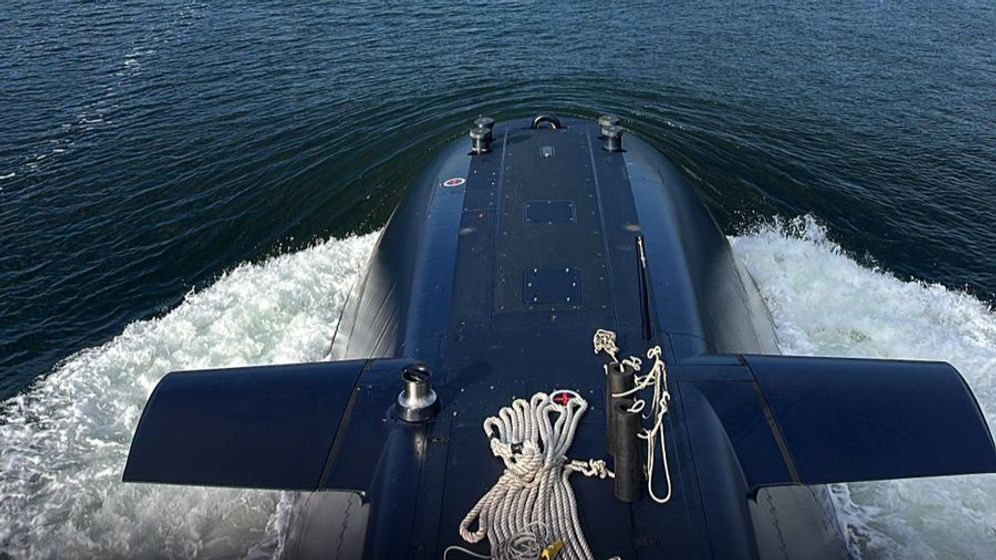
With the arrival of the INS Drakon submarine in Israel on Wednesday, the defense establishment is calling for the expansion of the Navy, as currently it is "too small for the challenges of the future."
Israel is currently monitoring the military buildup of various countries in the Middle East with developing naval fleets, such as Turkey and Egypt.
Turkey realized more than a decade ago the potential of the navy. The commander of the Turkish Navy coined the phrase "the Blue Homeland." A doctrine where they see the sea as a sovereign extension of Turkey, including the annexation of its economic waters.
According to an Israeli official, this represents significant potential to increase Turkey’s power projection and strength in the long term. Israeli assessments are that in the future Turkey will have 18 submarines (currently 12 and another 6 are planned), including an independent capability to produce submarines.
At the same time, the Syrian navy is beginning to re-arm with the help of the Turks, which places Israel at a crossroads. According to security sources, there is sufficient time to build up if the proper process is started in the near future. They recommend the acquisition of two additional submarines, semi-autonomous vessels, light Reshef-class corvettes and other means for naval warfare, preparation for combat on the open sea, and more.
The new submarine brings with it new capabilities and it is the largest ever to arrive in Israel. It took nearly 14 years to build the sophisticated vessel, and under the shadow of the war, its arrival in the country was even delayed by several months following Ireland and Norway's refusal to allow training in their maritime territory. It will take another two to three months for INS Drakon to become operational, after the installation of Israeli systems.
A senior official in the security establishment said that the blockage of Bab al-Mandeb should greatly worry Israel, among other reasons because it exposes the Mediterranean Sea to future risks and leads countries and organizations to impose a blockade on the State of Israel. In his definition, the closure of a strait is “asymmetric warfare” due to the circumstances. When the Houthis launch missiles from deep within Yemen toward a very narrow stronghold—it is almost impossible to effectively target them.
Suggested articles
- Pentagon quietly extends troop deployments as Iran war drags toward 2027 - report | i24NEWS
- Military training in Tel Aviv and undisclosed agreements, what is happening between Israel and Somaliland? | i24NEWS, Henry Kirshner
- 'Effective immediately:' Secretary of US Navy Phelan abruptly departs position amid ongoing Iran blockade | i24NEWS
INS Drakon: From Germany to Israel
After a journey of about 4,000 nautical miles from Germany, the INS Drakon, arrived in Israel on Wednesday. Upon its arrival, the submarine joins the new generation of submarines built in Germany as part of the security cooperation between the two countries.
INS Drakon is equipped with an Air Independent Propulsion (AIP) system, which enables the submarine to generate energy and recharge its batteries even during prolonged stays underwater, without the need to surface or use external air. The system uses oxygen and hydrogen to produce energy, thereby allowing for an extended duration of covert underwater operations and maintaining operational capabilities over time. This is the third AIP submarine in the Israeli Navy.
The submarine is over 70 meters (230 feet) long and is about 30% larger than the Dolphin-class submarines. Despite its size, less than one-fifth of its volume is visible above the water.
Its arrival marks the completion of the second generation of Navy submarines built in Germany, and signifies another milestone in the longstanding security cooperation between Israel and Germany.
The voyage from Germany to Israel took about a month, along a route of approximately 4,000 nautical miles, which is about 8,000 kilometers. The journey included sailing in the Atlantic Ocean, passing through the Strait of Gibraltar, and continuing through the Mediterranean Sea to Israel.
The construction of the submarine lasted more than 12 years, and after its completion, months of tests and preparations were carried out ahead of its arrival in Israel.
Throughout the project, there was close cooperation between the Israeli Navy, the German Navy, the German Ministry of Defense, and the professional parties involved in the construction of the submarine.
Israeli involvement in the project has been ongoing for about 20 years, through an Israeli project management team operating in Germany, which oversees the planning, construction, and testing processes. The management team is staffed by officers and engineers from the Navy, who come to Germany together with their families for periods of several years. At a later stage, crews from the submarine flotilla also join the project, participating in sailings and evaluations prior to the delivery of the submarines and their integration into the Navy.
Alongside technology, the Submarine Flotilla emphasizes the importance of human capital: submarine crews are required to maintain high levels of professionalism, responsibility, composure, and operational sharpness. The submariners operate complex combat systems and work for extended periods deep at sea and in remote theaters, under conditions of secrecy and isolation from the outside world. Israeli involvement in Germany continues to this day, with an eye toward the next-generation project—the Dakar submarines, which are currently under construction and represent the next generation of the Navy's submarines.