‘We refuse to disappear’: London conference seeks lasting Jewish-Kurdish partnership
Two-day gathering brought together politicians, academics and activists, as Foreign Minister Gideon Sa’ar backed closer ties and participants called for permanent links between Israel and the Kurds

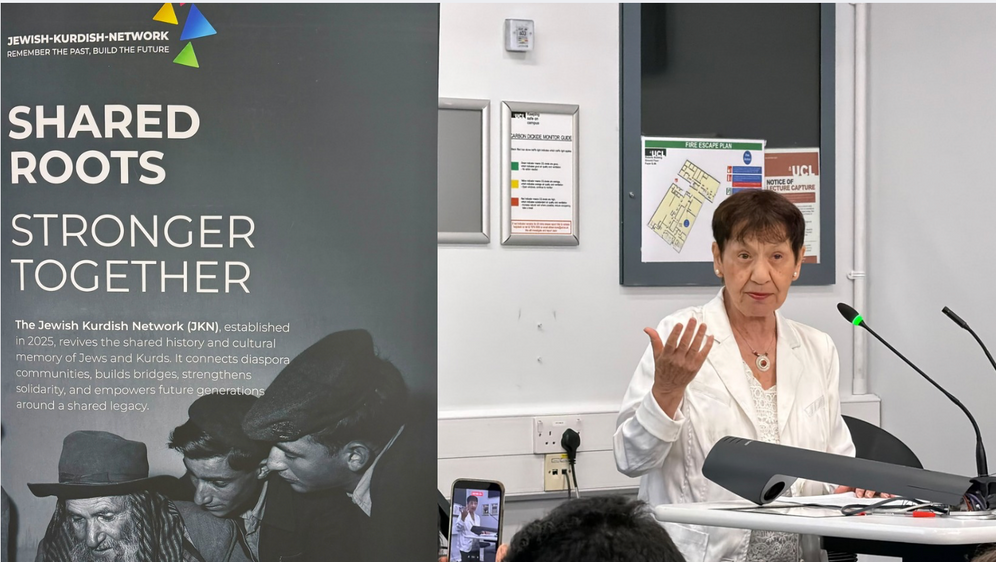
Jewish and Kurdish politicians, academics, journalists and civil society leaders concluded a two-day conference in London on Monday, calling for thousands of years of shared history to be transformed into lasting political, academic and cultural cooperation.
The conference, titled “Jewish-Kurdish Relations in a Changing Middle East,” was organized by the Jewish Kurdish Network and co-hosted by the London Centre for the Study of Contemporary Antisemitism and the Kurdish Studies Program at Tel Aviv University’s Moshe Dayan Center.
Across seven panels and a concluding roundtable, participants examined Kurdish and Jewish national movements, shared heritage, Western policy in the Middle East, genocide and collective memory, women’s leadership, diaspora identity and the role of the next generation.
Organizers said the gathering sought to move beyond expressions of solidarity and turn 2,700 years of shared history into practical, long-term cooperation between the two peoples.
The London gathering followed the first Kurdish-Jewish Congress in Berlin last year. Organizers said they hoped similar conferences would be held in other cities and develop into a sustained international network.
Sa’ar: Israel believes in strengthening Jewish-Kurdish ties
Israeli Foreign Minister Gideon Sa’ar addressed the conference in a recorded message, describing the relationship between Jews and Kurds as a long-standing friendship between two Middle Eastern minorities.
“The Kurdish people are a minority in four countries and, unfortunately, to this day have not achieved political independence,” Sa’ar said. “We believe in strengthening relations between minorities in the Middle East, specifically between Jews and Kurds.”
Ofra Bengio, head of the Kurdish Studies Program at the Moshe Dayan Center, highlighted the Kurds’ repeated resilience in the face of failed rebellions, genocide and political setbacks.
“Time and time again, I discovered the resilience of the Kurdish people,” said Bengio, who has studied Kurdish history for more than five decades.
One of the panels compared Zionism with Kurdiyati—the idea of Kurdish national consciousness and commitment to Kurdish identity.
Kurdish speakers said the two movements share a fundamental demand: the right of a people to determine its own future.
https://x.com/i/web/status/2096594670750969889
This post can't be displayed because social networks cookies have been deactivated. You can activate them by clicking .
Calls for Kurdish unity and permanent relations with Israel
A panel chaired by British MP Feryal Clark examined the changing regional order and Western policy toward Israel and the Kurds.
Ali Ertan Toprak, chairman of the Kurdish Community in Germany, called on Kurdish movements to place national interests above ideological and party divisions.
“Without the unity of the Kurdish people, we will achieve neither self-determination, nor freedom, nor our own state,” he said. “Before we ask for help from others, we must help ourselves.”
Toprak said his organization’s cooperation with Jewish communities did not begin in response to the October 7 massacre but had been developing for years. He noted that the Kurdish Community in Germany sent a delegation to Israel three months after the attack.
“We did that because, as Kurds, we know what it is like to be left alone,” he said.
British-Israeli analyst Jonathan Spyer accused Western governments of abandoning Kurdish partners in favor of authorities in Baghdad and Damascus that they believe can restore stability.
“We are currently in one of those familiar periods between the moment when the West makes a mistake and the moment when the West realizes it has made a mistake,” Spyer said.
https://x.com/i/web/status/2096988419528302734
This post can't be displayed because social networks cookies have been deactivated. You can activate them by clicking .
Women connect shared experiences of survival
The conference also focused on the role of women in Jewish and Kurdish societies.
Bengio said both Kurdish and Israeli women had historically taken on political and military roles, particularly during periods of conflict. Kurdish women, however, face the additional difficulties of living without a state and within societies that may remain deeply conservative.
Lisa Miara, the Jewish founder and president of the Springs of Hope Foundation, described her work rehabilitating Yazidi women and children rescued from ISIS captivity in Iraqi Kurdistan.
Miara said her organization gradually introduced Holocaust education after first addressing the survivors’ own collective trauma.
“We began to teach about other genocides—not diminishing theirs, but showing them that they are not alone in the world of suffering,” she said.
Kurdish journalist Suzan Quitaz drew parallels between her family’s deportation from Iraq and the experiences of Israeli women taken hostage on October 7. She recalled her mother seeing an image of Shiri Bibas holding her two young sons and recognizing the same terror she had experienced while fleeing Iraq alone with her children.
“We have been brutalized, but we stand and we thrive,” Quitaz said, calling on Kurdish and Jewish women to work together.
‘History alone is not enough’
Another panel placed younger Kurdish and Jewish voices at the center of the discussion.
Kurdish-Jewish political analyst Elyana Elyan described growing up in the Kurdistan Region before moving to Israel, saying the two identities had shaped both her personal life and her political work.
“Kurds and Jews are two indigenous peoples of the Middle East,” she said. “We have shared thousands of years of history, but history alone is not enough. What matters is what we do with our present.”
“We refuse to disappear,” she added, describing two peoples determined not merely to survive in their ancestral homelands, but to thrive.
Activists from the Kurdish regions of Iran and Syria also urged younger Kurds to question established political leadership, preserve the Kurdish language, build credible media and educational institutions, and develop relationships with Jewish communities that can survive changes in governments and regional alliances.
During the concluding roundtable, participants proposed academic exchanges, youth networks, joint cultural events, visits to Israel and Kurdistan, educational programs, greater attention to Kurdish and Jewish history in school textbooks and permanent dialogue between Israeli institutions and Kurdish organizations.
Bengio also proposed establishing museums abroad dedicated to the Anfal campaign and the Halabja massacre against the Kurds, modeled in part on institutions such as Yad Vashem in Jerusalem. She also advocated seeking Kurdish representation at the United Nations.
Edwin Shuker, an Iraqi-Jewish philanthropist, said holding a future conference in Israel could transform the relationship by bringing Kurdish representatives into direct contact with the country’s large Kurdish-Jewish community.
Nir Boms of the Moshe Dayan Center called for an institutional “track-two” channel—informal dialogue among non-governmental experts and leaders—alongside civil society initiatives. Spyer advocated permanent and, where possible, public ties between Israel and Kurdish political organizations.
In their closing remarks, organizers rejected the idea that Kurdish outreach to Israel was driven solely by opposition to common enemies, arguing instead that the relationship was rooted in thousands of years of shared history and mutual understanding.