Israel: College of the Brothers Jaffa, a school of multiculturalism
'Christian values are conveyed, but without the religious label because we are open to everyone'

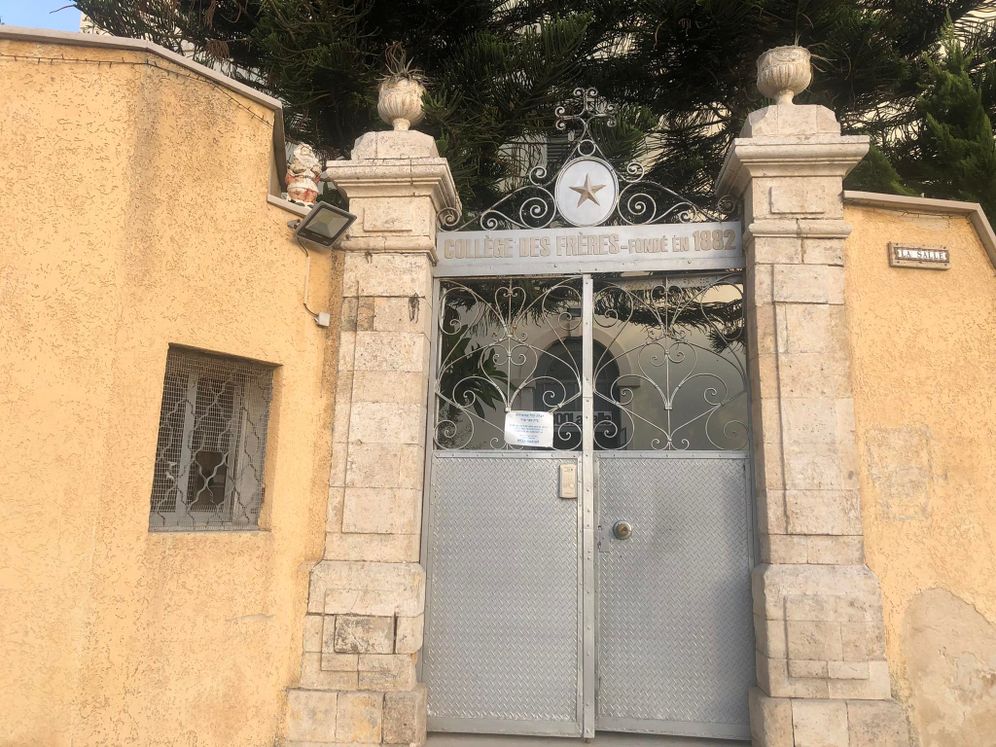
At the College of the Brothers Jaffa in Israel’s coastal city of Tel Aviv, the mission is simple: promote coexistence and offer a multicultural education to students starting in kindergarten.
Founded in 1882 by Lasallians and located in the heart of Jaffa, students of all denominations learn Hebrew, Arabic, English, and French from kindergarten to the end of high school, and have the possibility of getting either a French or Israeli diploma to gain access to universities in Israel or Europe.
Lasallian educational institutions are affiliated with the De La Salle Brothers, a Roman Catholic religious teaching order founded by French priest Saint Jean-Baptiste de La Salle, who was canonized in 1900 and proclaimed as the patron saint of all teachers of youth in 1950.
The school is made up of about 50 percent Muslim students, 25 percent Christian, and 20 percent Jewish and other religions.
They are all welcomed to the institution centered around a sense of community, respect for others, sharing, a sense of justice, and a commitment to resolving poverty.
The transmission of republican values, secularism, citizenship, a culture of commitment, and the fight against all forms of discrimination are also fundamental.
"The College of the Brothers exists in 80 countries including Israel, with an establishment in Jaffa and another in Jerusalem,” Céline Cateland-Sharon, a teacher at the school, told i24NEWS.
“Originally, it was a question, thanks to free education, of giving the same chance of success to all students, even the most disadvantaged,” she continued. “Today, our school is private, but the objective has not changed: we wish to offer an excellent education to the greatest number of children possible, and some even benefit from scholarships.”
"Christian values are conveyed, but without the religious label because we are open to everyone," Cateland-Sharon added.
Bayan, an Arab-Israeli resident of Jaffa, has been schooling her two children at the College of the Brothers Jaffa since kindergarten.
The young woman explained that she chose this establishment mainly for the plurality of languages taught: "We live in a mixed town, so my children since they were little have heard Arabic and Hebrew on a daily basis.”
“At home, I speak to them in Arabic and my husband tries to speak with them in English as much as possible. I wanted them to have an additional language with French, because in my opinion, a language is a gift that opens many doors", she said.
"As a minority in Israel, we are aware that our identity as Israeli-Arabs limits us, and for this, it was important to offer the children several options via languages,” Bayan continued.
“It is crucial that they grow up in a multicultural environment so that they have friends from all backgrounds and rub shoulders with children from different countries. It's a huge opportunity.”
In kindergarten, students learn Hebrew and French, and later on begin Arabic and English. They also have an hour of religious classes every day according to each person's faith, and Jewish lessons are given to everyone.
"This multicultural and multilingual context is exciting and very interesting. It also poses a lot of difficulties, but these interactions are very rich for the students", said Cateland-Sharon.
Dance, music, sports, and art lessons are also on the program. In primary school, Lasallian education courses take place once a week, which notably includes the various celebrations to get to know one's neighbor.
In addition, events aimed at enriching students’ educational paths are organized and parents can make presentations in class on various subjects.
For Fauzia, a mother of three and resident of Jaffa, schooling at the College of the Brothers is passed down through generations. Her father was a teacher there, and she herself studied in the establishment where her children were educated.
"According to my father, it is one of the best schools, especially thanks to the learning of the French language and culture. Although this teaching is removed from our mother tongue and our identity, it represents an incredible advantage,” she said.
Fauzia said that because of the mix in which she was immersed from an early age, her integration into university and working life as an Israeli-Arab was easier.
"This school is actually a reflection of what is happening outside, it teaches them very early on how to live together, like in Jaffa, which is a mixed city," she said.
Preparing to live together
The notion of coexistence is an integral part of the identity of the College of the Brothers.
"We try to make plans for the students to invite each other, to bring them closer," said Cateland-Sharon, adding that they become more friendly with those who speak the same language as them.
“When they grow up, the cultural differences are accentuated and they tend to separate to find themselves later, even if some integrate perfectly,” she assured.
Schools still too marginal
In the Tel Aviv region, the existence of this type of mixed school is still too rare, although initiatives are developing.
"Former President Rivlin developed the Tikva Israel program to diversify education and promote communication between communities, because I find education far too ‘ghettoized’,” said Cateland-Sharon.
“Unfortunately, we do not have enough means and tools to compensate for the lack of these establishments.”
Based on this model of diversity, the Koulanou Yahad (“All Together”) school opened its doors in Tel Aviv, thanks to the action of parents.