The Israeli metal star who turned hatred into a bridge- and watched it crack on Oct. 7th
Kobi Farhi grew up amid violence and once wanted revenge against Arabs. His music later became a phenomenon across the Muslim world. After October 7, everything changed

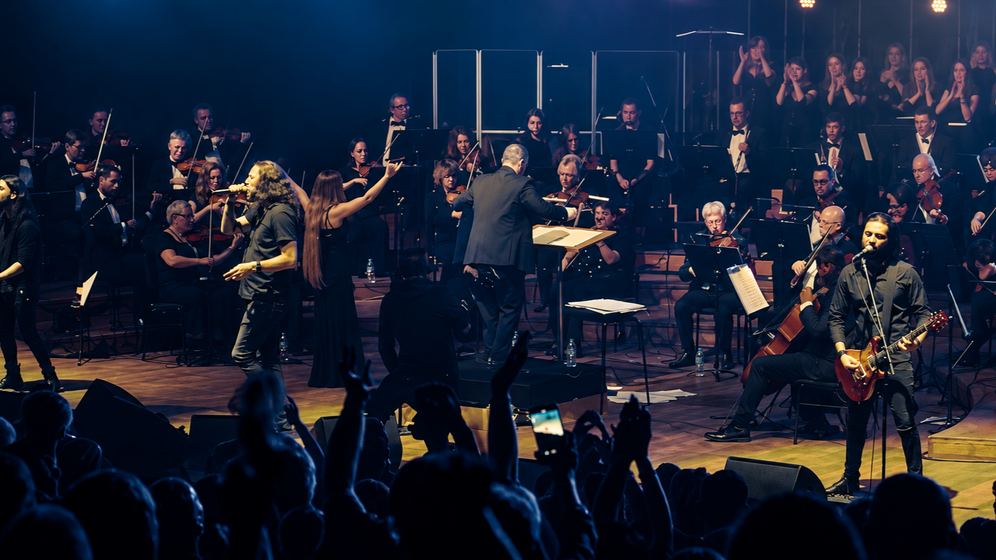
For more than three decades, Israeli metal band Orphaned Land has built an unusual bridge between Israel and the Muslim world. Now, after the October 7 attacks and the war that followed, the band’s founder and frontman, Kobi Farhi, is questioning whether that bridge can survive.
Orphaned Land is one of Israel’s best-known international music acts and a pioneer of Oriental metal, blending heavy metal with Middle Eastern musical influences and themes drawn from Judaism, Islam, Christianity, and the region’s shared history. The band has developed a particularly devoted following in Turkey and Arab countries, where some fans have even tattooed its logo on their bodies.
For Farhi, that connection began in the streets of Jaffa and Bat Yam, where he grew up surrounded by a mix of cultures and religions. “My whole identity is from Jaffa, unequivocally,” Farhi says.
He remembers growing up amid the call of the muezzin, church bells and synagogue prayers, with Arabic and Hebrew spoken around him. The multicultural environment, he says, gave him a sense of something both cosmopolitan and deeply rooted in the Middle East. But his path toward coexistence was anything but straightforward.
From anger to searching for “the sane ones”
One of the defining moments of Farhi’s youth came in 1992, when 15-year-old Helena Rapp was stabbed to death by a Palestinian terrorist on the promenade in Bat Yam. Farhi was 17 at the time.
He and his friends attended her funeral and then went looking for an Arab to attack.
“We decided that we wanted to lynch an Arab,” Farhi recalls. The group spotted a man they believed to be Arab and began chasing him while carrying wooden planks. A gas-station manager intervened, locking the man inside a room and preventing the attack.
Farhi says the incident left him with a deep anger, but also eventually forced him to confront the hatred he had embraced.
When he began forming Orphaned Land, he deliberately took the band in a very different direction. At 17, he posed for a band photograph wearing a keffiyeh. The cover of the band's first album featured a mosque.
For Farhi, the gesture was not an endorsement of any political leader or movement. It was a message to people on the other side.
“It’s like a call out to the other side: I respect you. I want to talk to you,” he says. He describes his goal as finding what he calls “the sane ones” among the people on all sides of the conflict. “I know there are crazy people,” he says. “I want to find the sane people and maintain a connection with them.” That idea became central to Orphaned Land’s music and Farhi’s personal mission.
When Arab fans turned an Israeli band into a phenomenon
The band's approach produced an extraordinary response. Farhi recalls a turning point in 2004, when a Jordanian fan sent him a video before a concert. The fan rolled up his sleeve and revealed an Orphaned Land tattoo.
“I said, an Arab tattooed my logo, of my Israeli band, on his arm?” Farhi recalls.
The tattoo, he says, represented something much deeper than buying a CD or wearing a concert shirt. The fan had permanently placed the symbol of an Israeli band on his body. The Jordanian fan then told Farhi that other supporters in Lebanon and Dubai had done the same. Farhi also recalls the story of an Egyptian fan who was reportedly imprisoned for months after being caught with the band's music.
For Farhi, those reactions demonstrated that the band's message had reached people who were searching for a different kind of relationship between Israelis and Arabs.
“Our messages landed on the people who needed them,” he says. The connection was sometimes openly displayed, even in places where doing so could be dangerous.
During a 2011 performance at France’s Hellfest festival, a Lebanese belly dancer appeared with a Lebanese flag and helped wave an Israeli flag alongside it. Farhi says the gesture was her own initiative.
“She couldn't return to Lebanon afterward, while we returned to Israel like heroes,” he recalls.
From Istanbul stardom to a world transformed
Turkey became one of Orphaned Land’s strongest markets. Farhi says the band performed in Istanbul dozens of times, at one point becoming so popular that he could walk through the city like a celebrity.
But he says that reality has changed dramatically.
Today, Farhi does not believe an Israeli can safely walk through Istanbul in the same way, pointing to the increasingly hostile political rhetoric toward Israel. The transformation became even more profound after October 7, 2023. The Hamas-led attack and the ensuing war shook Farhi personally and forced him to reconsider the bridge he had spent decades building.
A planned performance in Turkey was canceled because the band's safety could not be guaranteed. Questions also emerged about whether the band's long-standing dialogue with its Muslim audience could continue.
For the first time in three decades, Farhi removed the keffiyeh from his microphone. “I began sleeping with a knife under my mattress,” he says, describing the trauma he experienced after October 7.
“The feeling that the army didn't protect us created a trauma in me where I said, ‘Who knows, someone breaks into my house?’”
He says some members of the band moved sharply to the political right after the attack, a shift he says he finds difficult to judge.
Losing fans—and refusing to give up
The band also experienced a dramatic backlash online. Farhi says thousands of followers abandoned the band's social media accounts, while messages accused the musicians of being “two-faced” and “traitors.”
“Your bridge is starting to crack and break,” he says.
Yet Farhi insists that October 7 did not destroy his belief in coexistence. He makes an important distinction between people he sees as committed to violence and ordinary people with whom dialogue remains possible. “I have no interest in extending my hand to a man standing in front of me with an axe, or to a barbaric terrorist,” he says.
“But I still believe that we can find the sane ones within every nation and maintain a connection with them.” That conviction, however, has become harder to reconcile with the band's identity.
“The keffiyeh comes off, we don't play this song, we don't play that song—things have been shaved away from the band's existence,” Farhi says.
After 35 years, he acknowledges that he is going through a period of soul-searching. “The band is our life's work,” he says. “I don't want to think that the band is dead.”
An “orphaned land”
Farhi now divides his time between Israel and Greece. He says the cost of living, concerns over personal security and Israel's deepening social divisions contributed to his decision to spend part of his life abroad.
He has also turned his attention to writing. His new book, Orphaned Land, explores his life, his relationship with Israel and the journey that transformed him from an angry teenager into an international musician attempting to build bridges across one of the world's most divided regions. The book is also expected to become a film.
The title carries a deeper meaning for Farhi. “An orphaned land because the land is orphaned, soaked in blood, in wars and hardship,” he says. “It’s a tough place, our beloved country.”
Despite everything that has happened, Farhi has not abandoned the idea that inspired Orphaned Land in the first place. He still dreams of the day when he can reconnect with the Muslim fans who once embraced his Israeli band, even when doing so came with personal risk.
But for now, he is left with a difficult question—one that he asks at the end of his book and increasingly asks about his life's work: “Does the band still have a right to exist?”