New study: Why do men and women walk differently? The answer may lie with the neanderthals
Researchers found that the modern human male pelvis, not the human female pelvis nor the Neanderthal pelvis, represents the evolutionary innovation

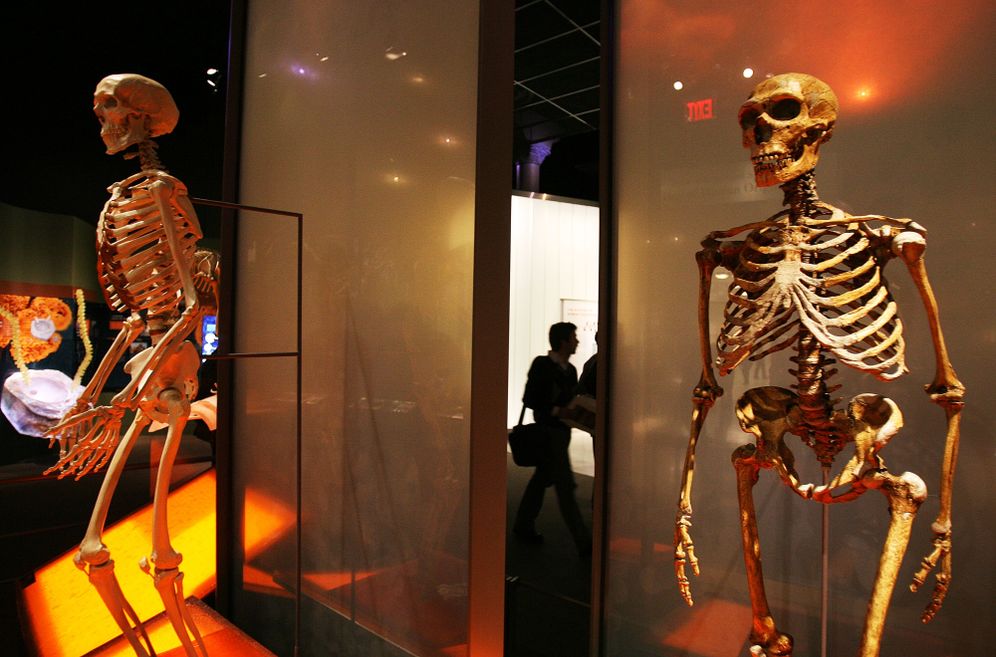
A new study by the Department of Anatomy and Anthropology at Tel Aviv University proposes a new explanation for why men and women walk differently, based on a comparison between Neanderthal and modern human pelves. The study, published in the journal Scientific Reports, was led by Prof. Yoel Rak in collaboration with researchers from Spain, the Technion, Bar-Ilan University and Ono Academic College.
The research compared two nearly complete male Neanderthal pelves, one from Kebara Cave in Israel and the other from Sima de los Huesos in Spain, with dozens of modern human pelves. The researchers found that, contrary to decades of assumption, it is the modern human male pelvis that represents the unusual structure, not the Neanderthal pelvis, which more closely resembles that of modern human females.
The study found that the hip joints of modern human males sit farther forward on the pelvic ring than those of modern human females or male Neanderthals. This positioning creates a biomechanical system in which thigh muscles attached to the front of the pelvis act like a spring, absorbing shock, storing energy, and releasing it with each step to improve walking efficiency over long distances.
Suggested articles
- Israeli scientists find oldest evidence of hybrid between Homo sapiens and Neanderthals | i24NEWS
- Excavations in Jerusalem's City of David uncover royal seal inscriptions from Judah's final days | i24NEWS, Henry Kirshner
- Baby Neanderthal skeletal pieces found in Israeli cave reveals surprising growth secret | i24NEWS
The shift in the position of the hip joints also required additional changes in pelvic anatomy, including thickening of the pubic bone and deepening of the anterior part of the pelvis to withstand the new mechanical loads. By contrast, due to the constraints of childbirth, the human female pelvis remains relatively shallow, with a relatively wide birth canal, say researchers. As a result, the female pelvis remained closer to the ancestral structure, the same structure found in male Neanderthals.
Prof. Rak explained that with every step taken by a biped, the body's center of gravity "falls" slightly downward, generating impact forces in the joints and requiring energy for the next step. He said the male pelvis structure allows thigh muscles to slow this downward movement, store elastic energy, and release it to propel the body forward.
The researchers said the female pelvis could not adopt the same changes because of the anatomical demands of childbirth, which require it to remain shallower with a wider birth canal. As a result, the female pelvis stayed closer to the ancestral structure shared with male Neanderthals.
"This study demonstrates how questions concerning human evolution are not only about the distant past," said Prof. Ella Been of Ono Academic College, one of the study's authors. "Understanding the evolution of our walking mechanism contributes to current research in biomechanics, musculoskeletal medicine, rehabilitation and injury prevention."
Prof. Rak said the findings shift how researchers should approach the evolution of the human pelvis. "It is not the Neanderthal pelvis that is the exception requiring explanation, but rather the pelvis of the modern human male," he explained. "The mechanism that evolved within it is the evolutionary innovation."