Syria’s revised textbooks elevate Islamist identity, sideline minorities; Israel still the “enemy” in curriculum
The review found that the changes came through selective edits to Assad-era textbooks rather than a full rewrite, and that they were applied unevenly

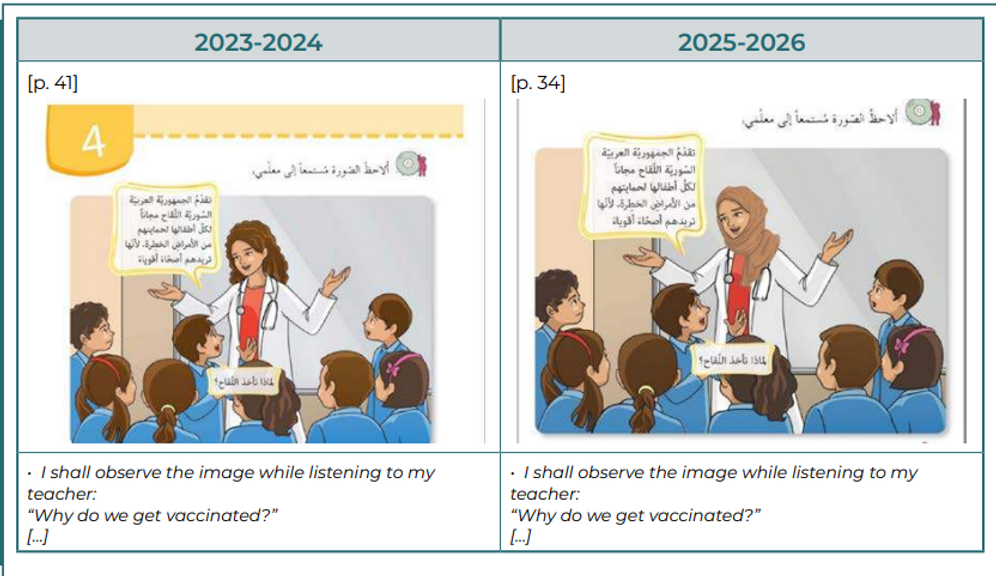
Syria’s national school curriculum for 2025 to 2026, the first under President Ahmed al-Sharaa, has replaced Assad-era Ba’athist and pan-Arabist content with Islamist political ideology, Sunni Muslim exceptionalism and pan-Islamist nationhood, according to a new report by IMPACT-se. The organization reviewed 130 textbooks for Grades 1 to 12 and compared them with the Assad-era versions published between 2011 and 2023.
According to the report, Islam is now presented as the central organizing principle of identity, law, and political order. Loyalty once demanded for Syria or the homeland is redirected toward Islam and the wider Muslim ummah.
Secular state law and democracy give way to shariah, counsel (shura), and divine authority. Science textbooks deleted or altered the Big Bang and evolution, and in one Natural Sciences book, “Nature’s gift” became “Allah’s gift.”
Sacrifice once made for “the homeland” is now made “for the sake of Allah,” and “resistance fighters” became “jihad fighters.” Martyrs who die in jihad are promised “eternal life in Paradise.”
The portrayal of women has also narrowed. Women are framed mainly as wives and mothers who are expected to obey their husbands, and references to Syrian civil law guaranteeing gender equality were removed. A hijab was added to many existing illustrations of girls and women, and in some early grade material girls were removed from scenes of learning and cooperation or replaced by boys.
One lesson on Islamic attire now advocates a full covering for women.
The textbooks dismantle the Assad cult of personality and replace it with an anti-Assad narrative. Hafez and Bashar al-Assad are portrayed as corrupt, sectarian, and authoritarian, and the 1970 “Corrective Movement” is reframed as a “military coup.”
The 2011 uprising is presented as a legitimate and morally justified revolution, culminating in what the books call the “Blessed Revolution” of 2024.
Regional alliances were also reshuffled. Iran is identified as an enemy and no longer praised for its 1979 revolution, while Hezbollah is cast as an accomplice to Assad, responsible for atrocities against Syrians. Turkey and the Ottoman Empire are now portrayed positively; references to “Ottoman occupation” were replaced with “Ottoman rule,” and revised maps show Hatay Province as part of Turkey, signaling an abandonment of Syria’s claim to the territory.
Syria’s minorities fare poorly under the revisions. The revisions removed or altered lessons promoting religious tolerance, as well as references to equality before the law and examples of early Muslim-Christian coexistence.
Christians remain visible, and their holy sites are still depicted, but the new content insists their presence is theologically subordinate to Islam and Islamic law. Kurds, Turkmen and Druze are almost entirely absent, and the Shi’i Fatimid Caliphate is delegitimized.
Jews are described in demonizing terms, denied a collective history and portrayed through antisemitic tropes. Jewish national identity is rejected outright, with Jews described as “a hodgepodge of peoples, not a single nation.”
Hostility toward the West persists. Europe and the United States are depicted as the principal civilizational adversary, defined by colonialism, greed, and military aggression, while the US is accused of invading Iraq to seize its wealth and oil. Israel remains consistently demonized. Its existence is denied, and it is called “enemy,” “thieving,” and “filth.”
Jewish military actions in the 1948 war are compared to “Nazi crimes against the Jews,” while Palestinian violence is justified and glorified. The report notes that the curriculum still asserts Syrian sovereignty over the Golan Heights, but that the territory is now framed as one of many occupied Muslim lands rather than a specifically Syrian national cause.
Suggested articles
Violence and martyrdom remain prominent across subjects. Armed conflict, whether termed “resistance,” “liberation,” “struggle,” or “jihad,” is presented as a defining feature of Islamic, Arab and Syrian history.
Islamic Education describes armed jihad as an individual obligation when Muslim lands, honor, wealth, or holy places are attacked. Poetry, prose and grammar exercises romanticize bloodshed and heroic death, while peace and reconciliation receive little attention.
The report acknowledges that the books also include ethical limits on warfare, nonviolent forms of jihad and the permissibility of temporary truces, but says these remain secondary.
The authors found that many changes proposed in the Ministry of Education’s January 2025 reform directives were carried out, though implementation was inconsistent, with the same instruction applied in one textbook and overlooked in another. They concluded that the removal of Ba’athist propaganda marks a rupture with Syria’s past, but that the new model does not yet show a parallel commitment to pluralism, critical inquiry, or reconciliation.