Listening for wildfires: the Israeli startup racing to hear flames before anyone sees them
As LA still reels from 2025's deadly fires, an Israeli startup's acoustic sensor claims it can detect a wildfire in under two minutes

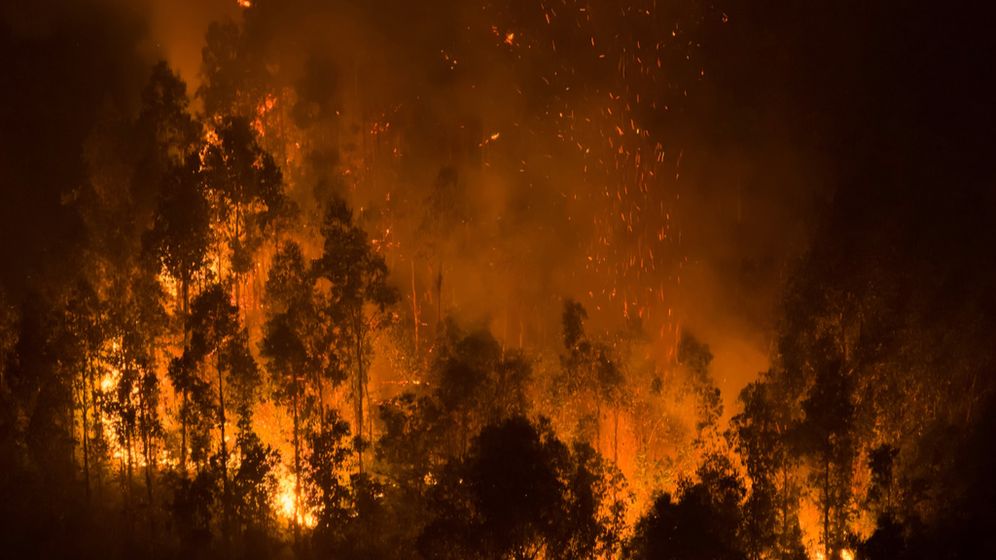
January 2025. Los Angeles is in flames. Wildfires rage across southern California — killing at least 31 people, burning through tens of thousands of homes, and displacing over 200,000. Today, about 70 percent of those people remain displaced — all because it took authorities too long to identify when and where the fire started.
Now, an Israeli startup says it has developed a solution that could prevent tragedies like this in the future. They're called Firewave, and they've developed an acoustic sensor that literally listens for fire, and can identify flames within just minutes.
Where it actually began: a wildfire in Greece
The idea for Firewave wasn't born in a lab. It was born on a family vacation. CEO Jenia Yurkovsky was traveling in Greece with his family, and they flew home to Israel just a day before a massive wildfire broke out on the island of Evia. "I was looking at these images of 30,000 people evacuating the island in a few days," he recalls. "And then I started to think that, okay, there must be a better way to know about wildfires coming."
That question sent him down a rabbit hole: what technologies already exist, and where do they fall short? He and his now co-founder and CTO, Eduard Grinberg — friends since they studied physics together at Tel Aviv University some 20 years ago — landed on a deceptively simple insight. "We can hear the fire, right? We can see the fire, smell and hear," Yurkovsky says. "So why not try to hear the fire. The signal is propagating with the speed of sound, so it should be very, very fast."
For the next year, they built a prototype in evenings and on weekends, alongside their day jobs, just to prove the concept before approaching investors.
Eventually Yurkovsky went full-time, the company was accepted into the Techstars accelerator — its first investor — and Firewave has since raised just over a million dollars, with a seed round opening in the coming weeks to fund its push into the U.S. market.
Why it matters: the Carmel Forest backdrop
To understand the urgency, it helps to stand in the Carmel Forest in northern Israel, where one of the worst fires in Israeli history broke out back in 2010. "It was a huge fire, about a million trees were damaged and 45 people were killed," Yurkovsky says. "While they were trying to suppress the fire, the water was evaporating even before they managed to hit the flames." And it's not an isolated story. "We see this pattern all over the world recently — because of climate change, the dryness of the surface, we see fires becoming more and more unstoppable."
The existing detection options, he explains, all have blind spots. Satellites are built for monitoring fires already underway, not catching small ones early. Cameras work well in open, flat terrain, but in dense forest they need a direct line of sight to smoke or heat — which can mean delays of 20, 30, even 60 minutes.
Gas sensors that "smell" smoke need dense deployment and still take tens of minutes, since enough smoke has to accumulate to be detected from a distance. "In our sense, we are basing our detection on sound," Yurkovsky says. "The signal is propagating with speed of sound, to all the directions, the same speed. So it's much easier to detect it."
How the sensor actually works
The hardware itself is built to disappear into the landscape. "This is one of our sensors here," Yurkovsky says, pointing to the device. "Here is the sensor itself with the microphones. We also have the humidity and temperature sensors and the solar panel." Mounted on a tree three to four meters up, it runs entirely off solar power and needs no maintenance for up to five years. Most of the time it's asleep to conserve energy, waking briefly every minute or two depending on the season, and only sends an alert when it actually detects a fire — what Yurkovsky calls a "passive system."
Each sensor currently covers roughly a 50-meter radius — one sensor per 10 dunams — with plans to extend that to 100 meters for small fires as the technology matures. Larger fires get picked up at greater distances. A single device costs somewhere between $100 and $200, plus an annual SaaS subscription, since the real product isn't one sensor — it's a connected IoT network. "If the fire is starting in one place and you cannot suppress it and it's starting to spread, our system can show you exactly how this fire is spreading," Yurkovsky says, since neighboring sensors pick up the same blaze as it grows.
So how fast are we actually talking? "We usually can detect a fire of about 1 square meter in 2 to 3 minutes," he says.
Once a sensor picks something up, it's connected to an app accessible on your phone or computer — and the second it detects a fire, it sends an instant alert. "We have a dashboard," Yurkovsky explains. "On the map you see each sensor as a dot. And if there is a fire, the sensor will turn red — you see the exact location. You can tap and it shows you the quickest road to reach the place and suppress the fire before it spreads." The alerts themselves are flexible too, routed to whatever channel a customer already uses — a messenger app, an API, or an existing emergency alert system.
Putting it to the test
So we decided to see it for ourselves. We started a small, controlled fire at 11 a.m. sharp, then waited to see how long it would take the sensor to pick up the sound.
It didn't take long. "Here it is," Grinberg said, watching the dashboard. "You can see it detected." All in, that took less than two minutes — compared to the 20, 30, even 60 minutes cameras can take to spot a fire in dense forest. That gap can be the difference between life and death.
Once firefighters get the alert, what happens next? "They receive the coordinates of the devices that detected the fire," Grinberg explained. "They can also hear the recordings of the fire to make sure that this is a fire." Speed matters even more when it comes to deploying a response from the air. "Drones have a very limited amount of water they can bring to the field," Yurkovsky points out. "So if we can detect such a small fire within minutes, they can fly in another 5–10 minutes and suppress it easily" — while it's still small enough for a drone to handle at all.
A cycle that needs cutting somewhere
There's also a feedback loop driving the urgency. About 10 percent of total global CO2 emissions come from wildfires, Yurkovsky notes, and those emissions feed the greenhouse effect, which worsens the climate crisis, which in turn fuels more wildfires. "This is like a cycle that we need to cut in some place," he says — and one goal of early detection is stopping a fire before it produces a huge burst of emissions in the first place.
The human factor
What's so crazy is that the vast majority of wildfires are started by people — 99 percent in Israel, Yurkovsky says, and about 85 percent in the United States, most by accident rather than on purpose. In Israel, it's illegal to light a fire in a public park — but plenty of people don't follow the rules anyway.
The financial stakes are enormous too. In the U.S. alone, wildfire damage is estimated to cost hundreds of billions of dollars a year. There are over 2.5 million homes located in what are classified as high-risk areas, which means insurance premiums are extremely high — and some insurance companies aren't even willing to cover those homes at all.
What's next
Firewave currently has 50 sensors deployed across Israel, with hundreds more planned for the U.S. and Canada this season. The hardware keeps evolving too — the newest model has the solar panel built directly into the sensor body and adds satellite communication for areas with no cellular coverage. "We are now building a mass production line for those," Yurkovsky says, "and we will be ready in a few months." The goal is to turn the race against wildfires into one humans can actually win — by hearing the fire before anyone can see it.
As Grinberg put it: "I hope this product will help people all over the world — and probably we can solve this problem once and for all."