The match that lasted three days: 16 years since tennis' greatest marathon
John Isner and Nicolas Mahut's legendary 11-hour, three-day Wimbledon battle shattered records, changed tennis forever, and remains unmatched 16 years later

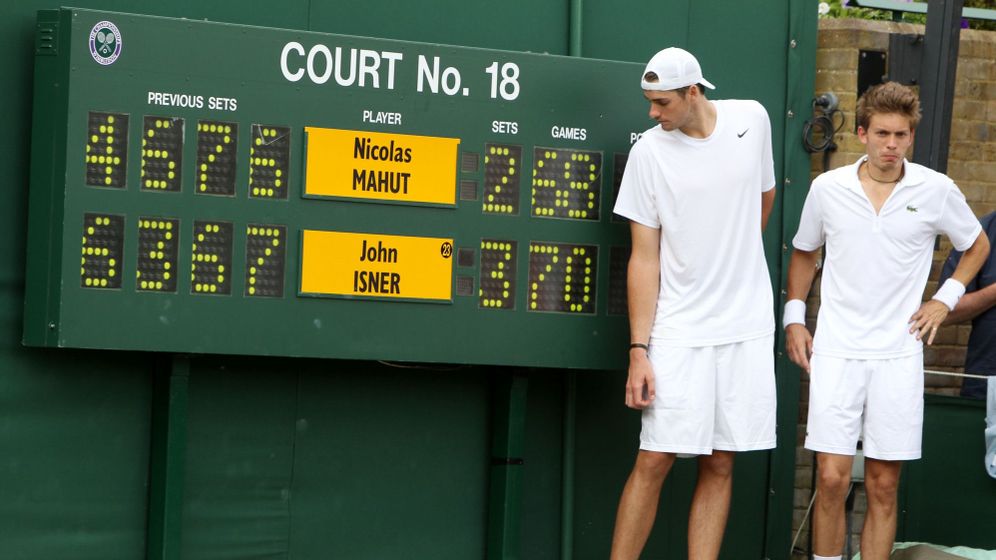
When American John Isner and Frenchman Nicolas Mahut stepped onto Court 18 at Wimbledon on June 22, 2010, they expected nothing more than a routine first-round match.
Instead, they produced one of the most remarkable contests in sporting history, a battle that lasted 11 hours and five minutes over three days, shattered seemingly unbreakable records, and changed the sport forever.
Sixteen years later, the Isner-Mahut marathon remains the longest match ever played.
At the time, Isner was ranked No. 23 in the world, while Mahut, ranked No. 148, had fought his way through qualifying to reach the main draw. Their match began at 6:13 p.m. on June 22, but the final point would not be played until two days later.
The opening stages gave little indication of the drama that was about to unfold. Mahut claimed the first set 6-4 before Isner responded with a 6-3 victory in the second. The next two sets were decided by tiebreaks, leaving the match level at two sets apiece. At 9:07 p.m., with the score tied and darkness descending over Wimbledon, play was suspended.
Players, officials, and spectators alike assumed the deciding fifth set would be wrapped up quickly the next day. Instead, that final set alone would become longer than most entire professional matches.
When play resumed on June 23, the expectation was that one player would eventually crack under pressure. Neither did.
Armed with booming serves and aided by Wimbledon’s famously fast grass courts, Isner and Mahut held serve again and again. The score climbed relentlessly: 10-10, 20-20, 30-30, 40-40 and beyond.
As the match entered unprecedented territory, Court 18 became the center of attention at the All England Club. Spectators abandoned the show courts and crowded around the small outside court to witness history. At one point, Wimbledon’s electronic scoreboard failed at 47-47 because it had never been designed to display such numbers. Technicians scrambled to repair it while the players continued their relentless duel.
Isner came within a point of victory four times during the second day, but Mahut saved every match point with extraordinary composure. As darkness fell for a second consecutive evening, umpire Mohamed Lahyani had no choice but to suspend play once again.
The score stood at an almost unimaginable 59-59 in the fifth set.
By the time the players returned on June 24, both men were physically exhausted. Every movement appeared painful. Yet neither was willing to surrender.
Court 18 had by then become a pilgrimage site. Fans packed every available viewing spot, climbed onto nearby rooftops, and lined fences several rows deep just to catch a glimpse of what had become the most famous tennis match in the world.
Despite the exhaustion, the battle continued. The score reached 68-68 before Isner finally earned another opportunity to end it. At 69-68, he stepped up for his fifth match point. Mahut approached the net, and Isner unleashed a backhand passing shot down the line. The Frenchman could not reach it.
After three days, 183 games, and more than 11 hours of tennis, the match was finally over.
Isner collapsed onto the grass in relief. Mahut stood frozen in disbelief. The final score read 6-4, 3-6, 6-7, 7-6, 70-68.
The match obliterated the sport's record books. It remains the longest match ever played and featured the longest set in tennis history. Isner struck 113 aces, still the most by a player in a single match, while the two men combined for an astonishing 216 aces.
The physical toll was immediate. When asked what he planned to do after the match, Isner joked that he wanted nothing to do with tennis for a while. Less than 24 hours later, he returned to the court for his second-round match completely drained and lost in just 74 minutes, failing to hit a single ace.
Still, the match transformed him into a star. He would go on to establish himself among the world's elite players, break into the top 10, and become American men's tennis' leading figure for much of the following decade before retiring in 2023 as the ATP Tour's all-time ace leader.
For Mahut, the aftermath proved far more difficult. The Frenchman later revealed that the defeat plunged him into a prolonged period of depression.
"I couldn't bear that I gave everything and still lost," he wrote in his autobiography. "For a long time, whenever I saw the numbers 70 and 68, I had a physical reaction. I would see that scoreboard in my nightmares."
Although he later reached a career-high singles ranking of No. 37, Mahut ultimately found his greatest success in doubles. He rose to world No. 1, won five Grand Slam doubles titles, and completed a remarkable redemption story when he captured the Wimbledon doubles title in 2016.
The Isner-Mahut epic did more than produce unforgettable drama—it permanently altered the rules of tennis. The sport's governing bodies concluded that forcing athletes to endure such extreme physical punishment was unsustainable. Over the following years, Grand Slam tournaments gradually introduced deciding-set tiebreaks, culminating in a unified rule adopted in 2022 that uses a first-to-10-points tiebreak when a final set reaches 6-6.
As a result, no player will ever again have to spend three days on court simply to advance to the second round of a tournament.
That is why Isner and Mahut's legendary 70-68 fifth set remains more than just a record. It stands as a monument to a different era of tennis—a once-in-a-lifetime contest that pushed the limits of human endurance and delivered one of the greatest spectacles the sport has ever seen.