From surprise attack to elimination of top Hamas & Hezbollah brass – 300 days of war
300 days after 250 people were kidnapped, 111 have been released in a deal or rescued in military operations – 115 are still there • i24NEWS' special report views the war through the camera lens

Nearly ten months ago, Palestinian terrorist factions led by Hamas launched a surprise cross-border attack on southern Israel. Around 1,200 individuals were massacred, marking the most lethal day in Israel's history and the most devastating for the Jewish community since the Holocaust.
In direct response, Israel embarked on a military campaign with the objective of eliminating Hamas. Half a year into the conflict, 133 hostages remain in Gaza and the IDF has planned to launch its next major maneuver into the southernmost city of Rafah on the border with Egypt, the last major Hamas stronghold and where many of the captives are believed to be held.
These are the major events that marked the first six months of Israel's war in Gaza:
October 7
At 6:29 a.m., Hamas militants launched a massive aerial attack triggering rocket alert sirens across south and central Israel and marking the start of the surprise invasion.
Thousands of terrorists crossed into Israel and attacked border communities and towns with a variety of heavy weapons, as well as the Supernova music festival that was taking place near the border.
1,200 people were killed that day and over 200 people were taken hostage into Gaza. Battles in southern Israel would continue over the following three days as the army rooted out the terrorists that had invaded.
October 8
Israel formally declared a state of war under Article 40A, the first such declaration since the 1973 Yom Kippur War. The stated aim was to eliminate Hamas's military capabilities and end its rule over the Gaza Strip.
300,000 reservists were called up, making it the largest mobilization in Israel's history.
October 17
An explosion at al-Ahli al-Arabi Baptist Hospital in Gaza City resulted in significant casualties, sparking widespread anger across the Arab world. Palestinians blamed it on an Israeli airstrike, while Israel claimed it was due to a misfired Palestinian rocket. The Hamas-run Gaza health ministry reported 471 deaths, a figure contested by Israel. An unclassified U.S. intelligence report estimated the death toll to be between 100 and 300, at the lower end of the spectrum.
October 18
U.S. President Joe Biden arrived in Israel in an unprecedented war time visit by an American leader, demonstrating his support for the Jewish State and attempting to avert a broader regional conflict.
October 20
Hamas released two American-Israeli hostages: Judith Ra'anan, 59, and her daughter Natalie, 17, who had been kidnapped from kibbutz Nahal Oz.
Additionally, 20 trucks carrying a first batch of humanitarian aid, excluding fuel, made their way into Gaza through the Rafah crossing.
October 27
After a week of limited tactical incursions, the IDF ground operation in Gaza officially began. IDF forces entering the north of the enclave, with the first mission being to encircle and then clear out Gaza City.
November 15
Israeli forces raid Gaza's largest hospital, Al-Shifa, claiming it was being used as a dual-purpose facility, serving both as a medical center and a Hamas military command post. This accusation was refuted by Hamas. Following the operation, Israel reported the discovery of weapons and additional evidence corroborating its claims of Hamas utilizing a network of tunnels beneath the hospital complex.
November 21
The Israeli government ratified a deal brokered by Qatar, Egypt, and the U.S., to exchange 150 Palestinian prisoners for 50 hostages. It also approved a four-day ceasefire in Gaza, with the possibility of extending it on a daily basis. However, Prime Minister Netanyahu clarified that Israel's military campaign against Hamas would continue following the ceasefire.
November 24-30
On Friday November 24, Hamas handed over the first group of hostages as part of the ceasefire deal. Every day, hostages would be handed over to Red Cross workers and taken to Rafah crossing, on the border between Gaza and Egypt, where they were then met by the IDF and flown back to Israel.
Over the course of the week-long truce, Hamas released a total of 105 hostages in exchange for 240 Palestinian women and teenaged security prisoners.
December 1
Following two extensions, ceasefire talks failed leading to a resumption of Israeli airstrikes on Gaza. Disagreements over the release of more hostages, including Israeli men and soldiers, led to the collapse of the truce. 136 hostages taken into Gaza on October 7 remained in captivity.
December 15
Three Israeli hostages were mistakenly killed during fighting in Shuja'iyya. The Israeli army confirmed the tragic accident in which Yotam Haim, Samar Talalka and Alon Lulu Shamriz, who were being held together, were misidentified and shot dead, despite waving white flags at the time.
December 29
South Africa initiated legal proceedings against Israel at the International Court of Justice in a case titled South Africa v. Israel (Genocide Convention). The accusation centers on alleged "genocidal acts" committed by Israel in Gaza.
South Africa went on to present its case on January 11, and Israel gave its defense the following day.
January 23
The IDF spokesman announced that Division 98 had completed its encirclement of Khan Yunis. Later that day, the IDF confirmed 21 soldiers were killed in the collapse of buildings in the Al-Ma'azi refugee camp area, in the center of the Gaza Strip.
January 29
Three IDF brigades surrounded and launched a raid on Shatti hospital. At the same time, forces began maneuvering underground inside the tunnel routes. Hundreds of terrorists were killed in face-to-face combat and aerial strikes.
That evening, rockets were fired at the Tel Aviv metropolitan area for the first time in a month.
February 12
"Operation Golden Hand": In a daring overnight operation, combined Israeli forces were able to rescue two abductees, Fernando Merman and Luis Har, who were being held in an apartment building in Rafah.
The two had been kidnapped from kibbutz Nir Itzhak, along with three family members who were released during the November truce.
February 18
Israel's Defense Minister Yoav Gallant announced that Hamas's Khan Yunis Brigade had been defeated.
February 26
IDF forces uncovered one of the largest tunnels connecting northern and central Gaza, spanning 10 kilometers (over 6 miles) with multiple offshoots.
After repeated raids on Hamas headquarters, the IDF wrapped up a significant portion of its ground campaign in most parts of the Strip.
March 9-10
In an overnight air strike, the IDF killed Marwan Issa, the deputy head of Hamas's military wing and considered the number three highest-ranking official in the terrorist organization. Confirmation of his death was slow to come out, first through Palestinian channels. The IDF confirmed the assassination on March 26.
March 18
Shifa hospital raid: Acting on Shin Bet intelligence, the IDF launched what would be a nearly week-long raid on Al-Shifa hospital, once of Gaza's main hospitals where Hamas had established headquarters on the compound. More than 200 terrorists were killed, including senior commanders, and about 800 suspects were arrested and taken for questioning.
Simultaneous to the hospital raid, the IDF brought humanitarian aid to the hospital, which included drinking water, food, medical equipment and a generator.
March 25
The UN Security Council passed Resolution 2728 which called for an immediate ceasefire in exchange for the return of the 130 hostages who were kidnapped from Israel and are being held in Gaza. The resolution also demanded the expansion of humanitarian aid to the population in the Gaza Strip.
March 31
Demonstrations led by families of hostages and grassroots activists turn chaotic. Following the rally, protesters outran police and reached the steps of Prime Minister Netanyahu's home in Jerusalem, breaching the barricades. The stormy protests drew condemnation from government ministers and the head of the Shin Bet Internal Security Agency said there was a clear line between "legitimate protest and illegal and violent protest."
April 1
Seven aid workers with the American NGO World Central Kitchen were killed in an airstrike in Gaza. An IDF probe determined that the "grave mistake" was caused by misidentification and acting against protocol; two commanders were dismissed from their posts. The tragedy spurred widespread condemnation from the international ceasefire, and caused President Biden to demand that Netanyahu address the humanitarian situation and close a ceasefire deal, or else he risked U.S. support.
April 2
Former Hamas hostages addressed the Knesset's Committee for the Advancement of Women at an emergency discussion on the situation of the abductees who are still in Hamas captivity. Released captive Mia Regev told lawmakers: "Every female in captivity is subject to sexual harassment."
April 11
Kibbutz Nir Oz observed a sad "Little Seder" without the abductees: on October 7, one of four residents of the kibbutz was murdered or kidnapped by Hamas - 51 of the kibbutz members were murdered and 36 were still held captive by Hamas in Gaza, including the last children who were not released in the deal for the abductees in November - Ariel and Kfir Bibas.
April 13-14
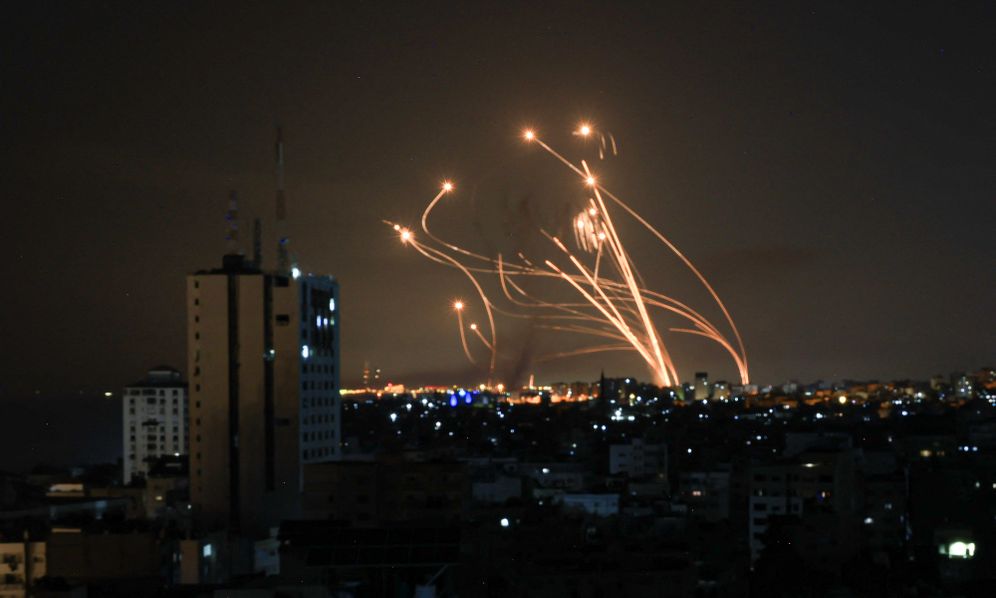
The night of the Iranian attack on Israel: in response to the assassination of Mohammad Reza Zahedi in Damascus, Iran launched approximately 130 ballistic missiles, 185 unmanned aerial vehicles and 36 cruise missiles at the State of Israel. The IDF's air defense forces, in cooperation with the US-led military coalition "B, Great Britain and France, succeeded in intercepting about 99 percent of the threats. Seven-year-old Amina Alhousani, a resident of the Bedouin diaspora in the Negev, was seriously injured in the head by shrapnel from an intercepted Iranian missile, and was released to her home on July 28.
April 17
Rachel Polin, the mother of the kidnapped Hirsch Goldberg-Pollin, was chosen as one of Time magazine's 100 most influential people. After the win she said: "I pray that this stage will help pressure the world not to abandon the 133 remaining abductees, who come from 25 countries, five religions and range in age from 15 months to 86 years. Their suffering must never be ignored."
https://x.com/i/web/status/1780606500328583437
This post can't be displayed because social networks cookies have been deactivated. You can activate them by clicking .
April 19
The Israeli response to the Iranian drone strike: In the early hours of the morning, an air force base was attacked. Hours later, an Israeli official confirmed to the American media that the attack was carried out by Israel - as a message to Iran about its ability to attack deep in enemy territory.
April 24
The terrorist organization Hamas released a video of the kidnapped Hirsch Goldberg-Polin in captivity. In the video, it is not clear when it was filmed, Hirsch is seen with an amputated hand and a haircut. During the documentary, which was apparently directed and filmed by the terrorist organization, he asked that he not be forgotten, and that he be released from captivity.
April 25
US President Joe Biden hosted the Abigail Idan, who was released from captivity by Hamas, at the White House. The president wrote on his X account: "Abigail is amazing, and recovering from her unimaginable trauma. The time we spent yesterday was a reminder of the work we need to do in order to free all the abductees."
April 27
The psychological terror of Hamas continued with the publication of another video of abductees Keith Siegel and Omri Miran. During the video, which was apparently directed and filmed by Hamas, the two asked that they not be forgotten.
May 6
The beginning of the ground maneuver in Rafah: After a day of the IDF warning locals to evacuate to the humanitarian zone in Mawasi (the IDF expanded the humanitarian zone which includes field hospitals, tents and increased quantities of food, water , medicines and additional supplies) with leaflets, text messages, phone calls, and media broadcasts in Arabic, the forces began to operate in the east of the city in the evening.
May 7
Kibbutz Nir Yitzhak announced that hostage Lior Rudaef was murdered on October 7 and his body was taken to Gaza. The announcement of his murder came following a new video found by IDF fighters in the Gaza Strip.
May 11
Hamas published a video of the abductee Nadav Popplewell, later, on June 3, the IDF announced his murder in captivity.
May 15
In a friendly fire incident in Jabaliya, central Gaza, five fighters from the Paratroopers 202nd Battalion of the Paratroopers were killed and eight others were wounded after tank shells fired by the 7th Brigade's 82nd Battalion. In addition, the IDF ended its operation in the A-Zayytun neighborhood in Gaza City.
May 17
The bodies of the abductees Shani Louk, Itzik Gelerenter, Amit Buskila were returned to Israel in a rescue operation in a special operation by the IDF and Shin Bet.
May 22
The parents of the five female observers who were kidnapped from the Nahal Oz base decided to publish the full video documenting what happened at the base on the morning of October 7th, as recorded by the body cameras of the Hamas terrorists.
May 24
The bodies of the abductees, Orion Hernandez, Hanan Yablonka and Michel Nissenbaum, were returned to Israel. The IDF forces were able to locate and rescue from Jabaliya the bodies of the abductees who were kidnapped on October 7. Until they were rescued, their families did not know their fate.
May 26
An international uproar erupted after the targeted killing of two senior Hamas officials in West Rafah, spurned by a fire that broke out after an Israel Air Force airstrike, with at least 45 Gazans dead. The IDF spokesman claimed that the attack was not in the humanitarian zone and published a conversation between two residents who claimed that there was a Hamas ammunition depot there.
May 28-30
Palestinian Islamic Jihad released two videos of the abducted Alexander (Sasha) Trupanov who was kidnapped from his parents' house in Nir Oz on October 7th.
June 3
The IDF spokesman announced that the abductees Haim Peri, Yoram Metzger, Amiram Koper and Nadav Poplev - died in captivity in Gaza. The decision to determine their deaths was based on intelligence information and was approved by a committee of experts from the Health Ministry, in cooperation with the Ministry of Religion and the Chief Rabbi of Israel. That morning the IDF spokesman announced that the late Dolev Yehud, who was considered kidnapped in Gaza until that day, was murdered October 7 in Kibbutz Nir Oz, and the remains of his body were found in the kibbutz.
June 8
Operation Arnon: In a raid by IDF forces on the Nuseirat camp, four Israeli hostages were rescued - Noa Argamani, Almog Meir Jan, Andrey Kozlov and Shlomi Ziv, who were kidnapped from the "Nova" party on October 7. During the rescue operation, there was an exchange of fire between the forces and the terrorists. The leader of the Israeli team, Arnon Zamora, was seriously wounded and his death was pronounced after a few hours.
June 13
The IDF destroyed a tunnel route 800 meters long (2625 feet) and 30 meters deep (98 feet) underground. At the same time, the US Central Command announced that the temporary pier established in Gaza for the purpose of transferring humanitarian aid was moved to Ashdod due to weather conditions. Up to this day, about 3,500 tons of equipment had been moved through the pier.
June 14
Four Hamas terrorists tried to enter Israeli territory through a tunnel shaft in Rafah. The attempt was successfully foiled by the Desert Patrol Battalion, butSergeant Major Zaid Mazarib, the tracker of the southern brigade, was killed in the battle. The tunnel was destroyed on July 17.
June 15
The names of eight fighters from the 601st Battalion of the Combat Engineers were allowed to be published, after the NMR was hit by an anti-tank missile launched by Hamas. In addition, it was allowed to be published that a fighter from the Givat patrol died of his wounds after being injured in the building collapse incident in Rafah on June 10.
June 18
The Hezbollah terrorist organization published a document that was filmed by the organization's spy drone over the Rafael factories in the north over the Haifa port.
June 23
Hezbollah has published the first part of the footage it took of their spy drone - dubbed the "Hudhud," or Hoopoe in English. The video included quotes from the last speech of the the group's Secretary General Hassan Nasrallah, during which he sent an explicit threat to Israel. Next to the documentation was written: "He who knows will understand."
June 27
The Air Force attacked terrorists who were staying at the Al Hasna school in Khan Yunis, which served as the headquarters of Hamas. At the same time, the IDF spokesman in Arabic called on the residents of Sheja'iyah to evacuate to the south, according to the start of IDF activity in the area. Documents coming from the Gaza Strip showed multitudes of miracles from their homes.
July 9
Release of Daniela Gilboa's video: Half a year after it was filmed, the observer's family approved the release of the Hamas psychological warfare video to the media. In the document, Daniela attacked the government in a text that was apparently dictated to her by the terrorist organization.
July 10
The late Noa and Nir Baranes, of Kibbutz Ortal in the Golan Heights, were killed after their vehicle was hit directly by a missile launched by Hezbollah into the area. Their eldest son, Matan, eulogized at the funeral: "Now I have a duty - to look after my brothers."
July 11
The IDF published the investigation into the battle in Kibbutz Be'eri on October 7. In the massacre of the kibbutz, 101 residents were murdered, and 30 abductees and two other abductees were abducted to the Gaza Strip. 11 of them are still being held in Gaza. During the fighting, 31 members of the security forces fell, including 23 IDF soldiers. and members of the standby squad, and eight policemen, and many fighters and civilians were injured.
July 13
The Israel Air Force attacked a compound in Khan Yunis after intelligence was received that Mohammed Deif and Rafa'ah Salameh, the commander of the Khan Yunis Brigade, were staying there. A day later, the Israeli Defense Forces confirmed Salama's elimination.
July 16
The families of the spotters Liri Elbag, Daniella Gilboa, Karina Ariev, Agam Berger, and Na'ama Levy who were kidnapped from the Nahal Oz base on October 7, revealed photos from their first days in captivity.
July 19
A UAV launched by the Houthis from Yemen exploded in the heart of Tel Aviv, claiming the life of Yevgeni Parder and injuring ten people. The flight path of the UAV that became clear days later revealed that it came through the Red Sea to the north, then crossed Egypt, and then broke east off the coast of Tel Aviv. There were long minutes when it was possible to intercept it, but due to a human error by the flight controller, Attention was diverted towards a cruise missile moving east.
July 20
A day after the fall of the UAV that was launched from Yemen to Tel Aviv, Israel Air Force fighter jets attacked targets in military use by the Houthi regime in the port of Hodeida, Yemen. This came after hundreds of drone and rocket attacks against Israel. The planes passed over the southern city of Eilat before the attack, which was a message to Iran because of the proximity of their oil installations to the site of the strike.
July 22
The IDF spokesman announced that the abductees Alex Dancyg and Yagev Buchshtab were killed in captivity and their bodies are being held by Hamas. The circumstances of their deaths are being investigated by the army, but according to the announcement they were killed during IDF operations in Khan Yunis.
July 24
The bodies of five abductees – Mia Goren and Rabid Katz, residents of Nir Oz; Oren Goldin, a resident of Nir Yitzhak; and Sergeant Kirill Brodsky and Sergeant Major (res.) Oren Goldin – were recovered. The bodies were hidden inside a tunnel in Khan Yunis.
July 23
Against the backdrop of Netanyahu's speech in Washington, and after the announcement of the two abductees' deaths in captivity, Einav Zangauker revealed a record of her son being held captive by Hamas in Gaza, as well as his last correspondence before he was kidnapped - and this after she reported that she had received his phone from the army officials.
July 24
Prime Minister Benjamin Netanyahu addressed US Congress for the fourth time in his life, becoming the first leader of another country to do so, against the background of the war. In his speech, which received enthusiastic support from the audience, he introduced Israeli heroes who sat in the audience. He also pointed out freed hostage Noa Argamani, who was rescued in a heroic operation from Hamas captivity, and families of abductees among the crowd. Later, Netanyahu held a series of political meetings with President Biden, presidential candidate Donald Trump, and with Vice President Kamala Harris, who is also running for president.
July 27
In the morning, a navy ship intercepted a Hezbollah UAV that was flying towards the Karish gas field. In the afternoon, the Majdal Shams disaster resulted in 12 children murdered after an Iranian-made Falaq-1 missile, with a fifty-three kilogram (117 pound) warhead, exploded on a soccer field in the Druze village in the Golan Heights. In addition, about thirty other children and teenagers were wounded in the incident and evacuated to the various hospitals in the area.
July 30
Four days after the severe disaster in Majdal Shams, in which 12 children and boys were murdered from a Hezbollah missile exploding inside a soccer field, Israel killed Fuad Shukr, Hezbollah's number 2 and Hassan Nasrallah's right-hand man. The IDF took responsibility for the attack, which was carried out using fighter jets, and clarified that it was conducted in response to the murder of the children in Majdal Shams, as well as the deaths of many Israelis and American soldiers.
July 31
The head of the political bureau of Hamas, Ismail Haniyeh, was killed in a precise attack in Tehran – it is yet unclear who is behind it, although Hamas and Iran blamed Israel. He stayed at a secret location and not a hotel due to security concerns while visiting to see the inauguration of President Masoud Pezeshkian. The elimination came a few hours after the assassination of Nasrallah's deputy by Israel in the heart of Beirut. American officials made it clear that the United States had no hand in the matter, and that they were not informed of the attack.
The house in Tehran where Ismail Haniyeh was eliminated 27a
August 1
Israel marks 300 days since the Swords of Iron war began. Symbolically, a funerary ceremony of Haniyeh is being held in Tehran before his burial Friday in Qatar, where he had lived for several years. Haniyeh led the terrorist organization during the war from abroad, and conducted the negotiations for a ceasefire. The IDF also confirmed the death of Hamas's Mohammed Deif, one of the top commanders in the Gaza Strip. The number of abductees still held by Hamas stands at 115. Protesters demanding a ceasefire and hostage release deal blocked Tel Aviv's major Ayalon highway.
Since the beginning of the ground maneuver in Gaza, 329 IDF soldiers have fallen in combat. And in the north, 44 people, soldiers and civilians, have lost their lives as a result of Hezbollah's brutal attacks. This adds to the casualties from the first day of the war, in which about 1,200 people were murdered.