What is Israel’s national animal?
From bird and butterfly to snake, scorpion, dog, gazelle and ibex, Israel’s national animals reflect the country’s landscapes, wildlife and identity

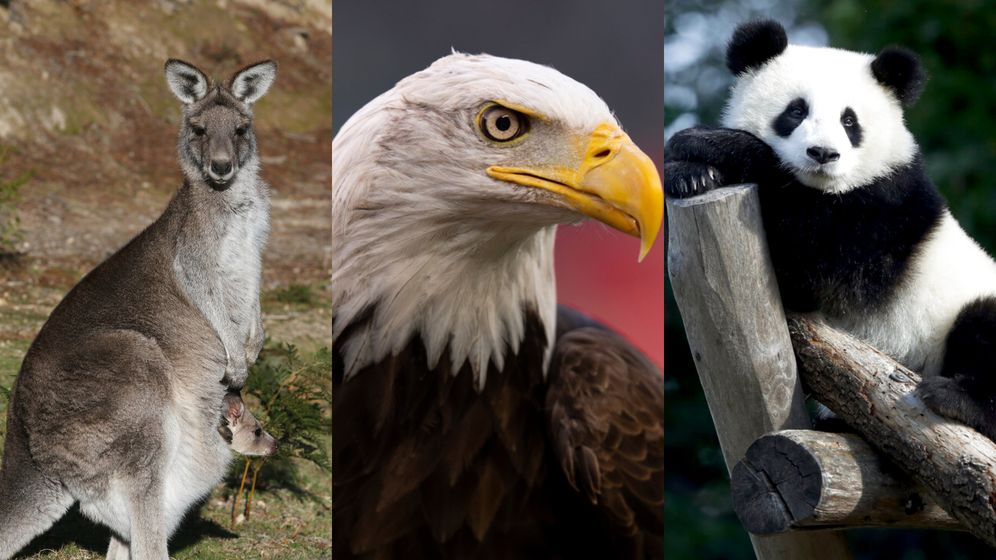
Every country has a handful of symbols that it proudly presents to its citizens and to the rest of the world. Alongside a flag, official emblem and national anthem, most countries adopt other national symbols drawn from nature and connecting the state to its territory, such as a national tree, flower and animal. In the modern world, choosing a national animal is an exercise in branding and identity: countries select animals that combine ancient tradition with the values and qualities they seek to claim as their own.
The United States chose the bald eagle to project strength, freedom and a sovereign view from above; France adopted the Gallic rooster, representing determination, tenacity and pride; and India selected the magnificent peacock, a symbol of beauty and spiritual splendor. Such choices are not driven by dry biological considerations, but by cultural narratives: the animal becomes a representation of the desired national character.
At the same time, a national animal connects a nation to its local landscape: the kangaroo is Australia, the giant panda is China and the Asian elephant is Thailand. In some countries, the national animal is not found within the country’s territory at all, as with Jordan’s Arabian oryx. In others, it does not even exist in reality, as with Scotland’s unicorn.
In Israel, while the flag, national anthem and menorah emblem enjoy an undisputed legal status, a single, overarching “national animal” has remained outside the statute books.
Instead, a unique and decentralized pantheon of national animals has emerged over the years: a bird, butterfly, snake, dog and even a scorpion. Each was chosen in its own way, and each reveals a different facet of the Israeli character. These are Israel’s national animals.
The national bird: the hoopoe
The hoopoe was crowned Israel’s national bird during celebrations marking the country’s 60th anniversary. Its selection was not the decision of a closed committee, but the result of a broad public and educational initiative. The hoopoe is not the archetypal eagle. It does not convey predatory strength or regal majesty.
With its magnificent crown of feathers, orange-brown coloring and slightly wild appearance, it represents a different kind of Israeliness. It is unmistakably local, commonly found in gardens and fields, with an unconventional beauty and inquisitive temperament. It projects an authentic Middle Eastern presence, while its victory in a democratic selection process gave it a degree of cultural legitimacy that made formal legal recognition unnecessary.
The national butterfly: the common blue
In recent years, Israel’s circle of national symbols has expanded to include creatures that might be regarded as unusual choices elsewhere. Consider the common blue, Israel’s national butterfly. The selection of a small, almost translucent butterfly reflects a growing environmental awareness. It conveys the message that national identity is built not only around the large and impressive, but also around the delicate and fragile.
The common blue compels us to examine Israel’s “micro-landscape,” appreciating the pollinators and delicate ecosystems that allow the country’s natural world to survive. It is a symbol concerned not with conquest or strength, but with conservation and attentiveness to the environment.
The national snake: the Palestine viper
The serpent known in English as the Palestine viper was crowned Israel’s national snake in 2018 following a democratic selection process involving tens of thousands of citizens. Its selection, despite being a venomous predator that naturally inspires aversion in many people, symbolizes an Israeli acknowledgment of the complexity of the local environment. The viper is the most common snake in Israel’s populated regions, and its familiar presence, from the Galilee to the northern Negev, has made it an inseparable part of Israeli folklore and everyday life.
Beyond its symbolic image as a strong, adaptable animal capable of surviving changing conditions, its selection was also intended to serve an educational and ecological purpose: transforming a mythological “enemy” into a valued and protected part of the natural ecosystem. As a predator that feeds on rodents, the viper plays an essential role in maintaining the biological balance. Its adoption as a national symbol reflects a mature approach that seeks to replace fear with awareness, conservation and respect for local wildlife.
The national scorpion: the Jericho scorpion
Alongside a national snake, Israel has also chosen a national scorpion. The selection of the Jericho scorpion, the largest scorpion in Israel and capable of reaching a length of around 13 centimeters, was driven first and foremost by its impressive, almost noble appearance. It is black or dark brown, with large, powerful pincers that give it the appearance of ancient armor.
Despite its intimidating size, it is not considered dangerous to humans, unlike Israel’s common yellow scorpion. This made it possible to transform the Jericho scorpion into a symbol of strength and desert serenity rather than terror.
Its name directly connects it to the landscapes of the Land of Israel: the Jericho region, the Jordan Valley and the Judean Desert. Its selection symbolizes Israel’s desire to recognize the beauty of its harsh, untamed natural environment and to grant a place of honor even to the hidden creatures that inhabit rocky crevices and desert expanses.
The national dog: the Canaan Dog
Alongside Israel’s wild animals stands the Canaan Dog, the country’s national dog. Its story is one of an ancient bond between humans and animals. The Canaan Dog is a local breed whose roots stretch back thousands of years to the nomads and shepherds of the Levant. It survived harsh conditions through intelligence and independence.
Its adoption as a national symbol connects the country’s archaeological history with contemporary life. It represents the agricultural memory of the land and the partnership between humans and animals within this geographical space, forming a link between the natural wilderness and settled human culture.
Why does Israel not have a single national animal?
In many countries, the national animal is designated from above as part of an orderly government initiative. In Israel, the process has been civilian, decentralized and sometimes even contentious. Israelis remain divided over which animal best represents the country.
Several animals nevertheless appear on government and cultural emblems. The mountain gazelle is woven into generations of Hebrew literature, prayer and poetry, and appears on the emblem of Israel’s postal service. It is now endangered, however, and relatively few remain in the wild.
Alongside it is the Nubian ibex. For years, it has been regarded as a symbol of nature conservation in Israel, which is home to the world’s largest population of the species. It also appears on the emblem of the Israel Nature and Parks Authority.
The inability, or unwillingness, to select a single animal reflects the fact that Israel has no single, all-encompassing narrative. Israeli society is a mosaic of communities, landscapes and worldviews, with each group finding itself reflected in a different animal.
Rather than choosing one animal to represent everything, Israel has created a collection of symbols reflecting its biological and cultural richness. Instead of a remote and abstract “Israeli lion,” it has acquired an entire zoo of symbols living alongside its people in gardens, fields and deserts. Together, they form a complete, complex and fascinating portrait of the country and Israeli society.