From Dimona to arms embargoes: How Israel's alliance with France unraveled
France helped build the Dimona reactor and supplied Israel with the aircraft used to win the Six-Day War. Now things look different. A look at the collapse of the golden age in Israel-France relations

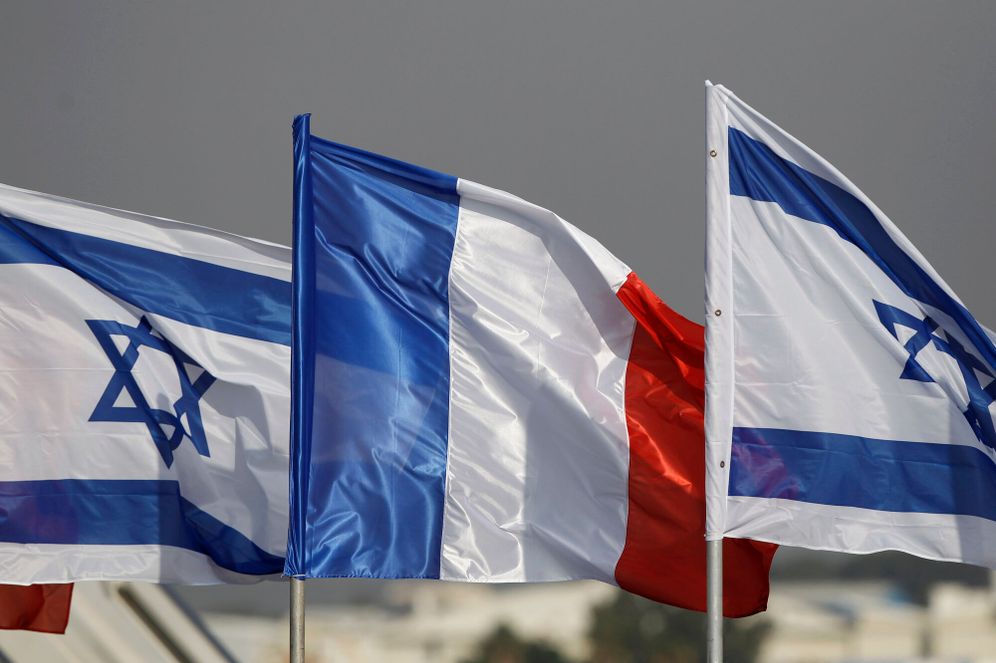
On the morning of June 5, 1967, as the Israeli Air Force’s Mirage III aircraft took off for Operation Focus, which opened the Six-Day War, and pounded Egyptian airfields, the dramatic military victory that would become etched in Israel’s national memory rested to a considerable extent on French engineering and defense manufacturing. Historians and diplomats regard the 1950s and 1960s as the “golden age” of relations between the young Jewish state and France. Paris was not merely the Israeli military’s exclusive arms supplier: it was Israel’s leading strategic partner, laying the foundations for the nuclear research center at Dimona and standing alongside Israel in the 1956 Sinai campaign.
Sixty years later, the diplomatic picture is entirely different. The Élysée Palace, which once opened its doors to Israeli leaders and defense chiefs, now takes one of Europe’s toughest and most critical positions toward Israel. The exclusion of Israeli defense companies from prestigious arms exhibitions, President Emmanuel Macron’s public call for an embargo on weapons used by Israel in the Gaza war, and French support for legal and diplomatic initiatives against Israel at the United Nations and the court in The Hague mark one of the lowest points in relations between two countries once considered close allies.
The beginnings of the alliance: From the Exodus to the arms of 1948
France’s connection to the Zionist project emerged in the shadow of the trauma of World War II and Paris’s deep hostility toward Britain for forcing it out of its mandates in Syria and Lebanon in 1945. For the French government, helping the Jewish underground organizations in their struggle against the British offered an opportunity to settle an old score. France became a clandestine base for the state in the making. Dramatic operations bringing Jewish immigrants to Palestine were organized and launched from French soil, including the famous departure of the Exodus from the port of Sète in 1947. The French authorities turned a blind eye, allowing Haganah, Irgun and Lehi commanders to operate, raise funds and establish headquarters in the heart of Paris.
When the War of Independence broke out in 1948, with the United States and the United Nations imposing a strict arms embargo on the Middle East, France was among the few countries to open its doors to Israel’s arms procurement network. Artillery, ammunition and essential military equipment flowed to Israel through French ports and airfields, helping it fight the war alongside the weapons arriving from Czechoslovakia. Paris’s support for the UN partition plan on November 29, 1947, and its formal recognition of Israel in 1949 also laid the diplomatic foundations for the relationship that followed.
The secret arms alliance: The covert deal that brought Israel the Dimona reactor
In the first half of the 1950s, the young State of Israel faced severe diplomatic and military isolation. The United States maintained a strict policy of withholding lethal weapons from the Middle East to avoid setting off an arms race, while Britain was viewed in Jerusalem as historically aligned with the Arab monarchies. France’s Fourth Republic filled the vacuum, driven by a convergence of strategic interests. Paris was then embroiled in a bloody war against the Algerian insurgents of the National Liberation Front, or FLN, and regarded Egyptian President Gamal Abdel Nasser, the rebellion’s principal financier and supporter, as a direct enemy. The French view that “the enemy of my enemy is my friend” opened the way for an unprecedented strengthening of ties with Israel.
Israel’s Defense Ministry, led by its young director general, Shimon Peres, and fully backed by Prime Minister David Ben-Gurion, recognized the opportunity and found a receptive audience in Paris. The strategic connection led to a secret meeting in a Paris suburb in October 1956, where France, Britain and Israel planned their three-country coalition for the Sinai campaign against Egypt. Under the arrangements, France provided Israel with naval and air protection, along with heavy military equipment unloaded at Kishon port.
The alliance reached its peak a year later, in October 1957, with the signing of a separate secret agreement under which France agreed to provide Israel with technology, engineering expertise and critical components for the nuclear research center at Dimona. At the same time, France opened Dassault’s production lines to Israel, supplying the Israeli military with Ouragan and Mystère aircraft, followed by the Mirage III jets that became the spearhead of the Israeli Air Force and secured Israel’s regional air superiority.
De Gaulle’s ultimatum: The strategic turning point of 1967
The dramatic shift came in the spring of 1967, on the eve of the Six-Day War. President Charles de Gaulle, who had ended the Algerian War in 1962 and developed an independent doctrine that kept Washington at a distance, decided that France’s interests lay in closer ties with the Arab world and developing countries.
As tensions mounted in May 1967, de Gaulle warned Israeli Foreign Minister Abba Eban during their meeting at the Élysée Palace that if Israel initiated a war, France would withdraw its diplomatic and military support. “Do not be the first to fire,” de Gaulle urged.
When fighting broke out on June 5, de Gaulle carried out his threat and imposed a complete arms embargo on the Middle East. In practice, the measure disproportionately harmed Israel, which depended almost entirely on French arms purchases. The embargo included withholding 50 advanced Mirage 5 fighter jets that Israel had already paid for in full, as well as refusing to supply essential spare parts for its existing aircraft.
The diplomatic rupture extended beyond military affairs. At a historic press conference in November 1967, de Gaulle stunned the world by describing the Jews as “an elite people, self-assured and domineering.” The remark deeply shocked Jerusalem and revealed an ideological divide, rather than a merely tactical disagreement. The French embargo abruptly severed the military alliance and prompted Israel to make a momentous strategic decision: to rely fully on the United States while investing vast resources in building a substantial domestic defense industry.
Yet before supplies were cut off completely, another drama unfolded that seemed straight out of a Hollywood film. Under Project Shalechet, devised in the late 1960s, five advanced Sa’ar 3 missile boats were built in the French port city of Cherbourg. Although Israel had already paid for them in full, the French government’s total embargo blocked their delivery, leaving them at the dock under a presidential order forbidding their departure. Israel’s defense establishment refused to accept the situation. Instead of risking an outright violation of the law, it devised an ingenious international deception: securing the boats’ release by carefully exploiting loopholes in French law while fully complying with international maritime law, through their purported “sale” to a Norwegian civilian oil-drilling company.
The Christmas celebrations on December 25, 1969, provided the perfect cover. Taking advantage of a fierce storm that had brought the port to a standstill, the five boats slipped out to sea and began a daring, unprecedented voyage. Over six days, they navigated a stormy, winding route of more than 3,000 nautical miles, or over 5,500 kilometers, from Cherbourg to Haifa, refueling at sea in a complex logistical operation involving Israeli merchant ships and a passenger liner. On December 31, 1969, New Year’s Eve, the boats entered Haifa port to an emotional welcome. The operation is regarded as one of the most complex in Israeli military history, but it also definitively closed the era of French military support for Israel.
Building Iraq’s reactor and terrorism on the streets of Paris: The 1970s and 1980s
During the 1970s, under presidents Georges Pompidou and Valéry Giscard d’Estaing, France’s “Arab policy,” or politique arabe, became increasingly entrenched. A clear expression of this policy came in the second half of the decade, when France signed a major deal with Iraqi ruler Saddam Hussein to supply an advanced nuclear research reactor. The French move caused deep alarm in Jerusalem and led to a series of covert attempts to thwart the project, culminating in the reactor’s complete destruction by the Israeli Air Force in Operation Opera in June 1981. Paris strongly condemned the attack.
Alongside these security tensions, the 1980s brought a wave of terrorism that struck at the heart of the French capital. Deadly attacks on Jewish targets, including the bombing of the synagogue on Rue Copernic in 1980 and the attack on Jo Goldenberg’s Jewish restaurant in 1982, showed that the Middle East conflict was no longer confined to distant shores but was spilling directly onto French streets.
The election of President François Mitterrand in 1981 was seen in Jerusalem as a chance for a reversal. Mitterrand, who showed a warm affinity for Jewish history, arrived in Israel in 1982 for the first visit by a French president. But speaking from the Knesset rostrum before then-Prime Minister Menachem Begin, he made clear that the warmth had firm limits. Mitterrand openly called for a Palestinian state and endorsed Europe’s 1980 Venice Declaration. His message was clear: France was willing to engage with Israel at the highest level, but would make no concessions on its “Arab policy.”
The Chirac years: From mediation in Lebanon to a public confrontation in Jerusalem
In the 1990s, under President Jacques Chirac, France sought to restore its standing as a key player in the Middle East, with particular emphasis on Lebanon. During the Israeli military’s Operation Grapes of Wrath in Lebanon in 1996, Paris became deeply involved in diplomatic efforts. Alongside the United States, it led the drafting of the understandings that ended the fighting and established an international monitoring mechanism in southern Lebanon, cementing France’s direct influence along Israel’s northern border.
In October that same year, one of the most recognizable episodes in the tensions between the countries took place. During an official visit to Jerusalem’s Old City, Chirac became involved in a loud, televised confrontation with Israeli security service bodyguards. Furious at the tight security arrangements that kept local residents away from him, he shouted at the guards in English that if this was how they behaved, he would rather return to his plane. The incident immediately became a symbol of the diplomatic friction and differences in outlook between the French government and Israel’s security establishment.
A hard line on Iran and bloodshed at Hyper Cacher: Disagreements persist despite a shared threat
During the first two decades of the 21st century, the relationship displayed a striking complexity. President Nicolas Sarkozy, who had some Jewish ancestry, was regarded as one of the leaders most sympathetic to Israel. He strengthened economic and intelligence cooperation between the countries and described Israel’s security as a “red line.” At the same time, Sarkozy maintained France’s firm opposition to construction in the West Bank and repeatedly voiced pointed criticism of Israeli policy.
Under President François Hollande, a surprising area of strategic alignment emerged. During the negotiations over the Iranian nuclear agreement between 2013 and 2015, France took a particularly tough position toward Tehran, one that was more consistently demanding even than Washington’s and earned quiet appreciation among senior Israeli officials.
January 2015 brought Paris and Jerusalem a bloody reminder of their common enemy. The wave of Islamist terrorism that shook the French capital, from the massacre at the offices of Charlie Hebdo to the deadly attack on the Hyper Cacher supermarket, where four Jewish civilians were murdered, produced a rare moment of shared destiny. The image of Prime Minister Benjamin Netanyahu marching alongside Hollande and world leaders in a demonstration attended by millions conveyed a united front against terrorism. Beneath that international display of solidarity, however, the murders at the kosher supermarket opened a deep wound and fundamentally shook French Jews’ sense of security. Many chose to immigrate to Israel.
The Macron era: A shifting course under domestic pressure
Since taking office in 2017, Emmanuel Macron has pursued a delicate balancing act toward Israel, combining close security and technological cooperation with consistent criticism of its policies. He maintained warm ties with Israel’s leadership and kept channels of communication open. Beneath the diplomatic courtesies, however, the Élysée Palace took a tough position on the Israeli government’s policies. Macron publicly opposed plans to annex parts of the West Bank, consistently condemned settlement construction and repeatedly insisted on advancing a two-state solution and providing the Palestinians with a “political horizon.”
A particularly memorable incident during Macron’s official visit to Jerusalem in January 2020 recalled Chirac’s earlier confrontation. While touring St. Anne’s Church in the Old City, a compound owned by France since the 19th century, Macron became angry with Israeli security personnel who tried to enter with him. He shouted at them to leave, saying: “Respect the rules that have been in place for hundreds of years ... This is French territory.” Despite the president’s swift subsequent apology, the incident strongly echoed France’s traditional stance toward Israel.
Following the October 7, 2023, massacre and the war that followed, relations between the Élysée Palace and Israel’s political leadership deteriorated to an unprecedented low. In the first days after the massacre, Macron proposed an international coalition against Hamas modeled on the coalition that fought Islamic State. As the fighting continued, however, Paris completely changed its position and moved to the forefront of European criticism.
France’s tougher stance took the form of a series of practical and public measures. The French government made an unprecedented decision to prevent Israeli defense companies from participating in defense exhibitions and events. The move provoked fury in Jerusalem and was seen as a direct blow to Israeli defense exports. Macron subsequently said in an interview with French media that the only way to halt the regional escalation was to stop supplying offensive weapons used in the fighting in Gaza. Tensions intensified further over France’s involvement in Lebanon and incidents in the country’s south, prompting Paris to accuse Israel of undermining regional stability.
Demographics and international prestige: The deeper forces behind French policy
The shift and hardening of Paris’s position are neither accidental nor simply a matter of a particular president’s personality. They are driven by three underlying structural factors. The first and most significant concerns domestic politics and French demographics. France is home to the largest Muslim community in Western Europe, comprising around six million people, or roughly 10% of the country’s population. Tensions in the Middle East spill directly onto French streets, into the suburbs and into the political system. The government in Paris is highly sensitive to the prospect of tensions between communities in major cities.
The second factor is the Gaullist diplomatic doctrine, named after de Gaulle, which seeks to maintain an independent position distinct from US policy. Paris sees itself as an honest broker and a diplomatic bridge between the Western world, the Global South and the Arab world. It believes that a firmly critical position toward Israel strengthens its international standing in those regions.
The third concerns France’s historical and cultural ties to Lebanon and the Middle East. France regards Lebanon as part of its historical and strategic sphere of influence, and sees any major military escalation in southern Lebanon as a direct threat to its national interests. France’s journey from the secret arms alliance and the Dimona reactor of the 1950s to today’s exhibition bans and public confrontations reflects a profound process in which national interests, domestic considerations and great-power rivalries pushed aside one of the most significant alliances in Israel’s history.