Tsurkov speaks on her captivity: 'I learned a great deal because of this horrible situation'
Middle East researcher Elizabeth Tsurkov joins i24NEWS' On The Record to discuss her two-and-a-half years in captivity after being held hostage by Kata'ib Hezbollah in Iraq

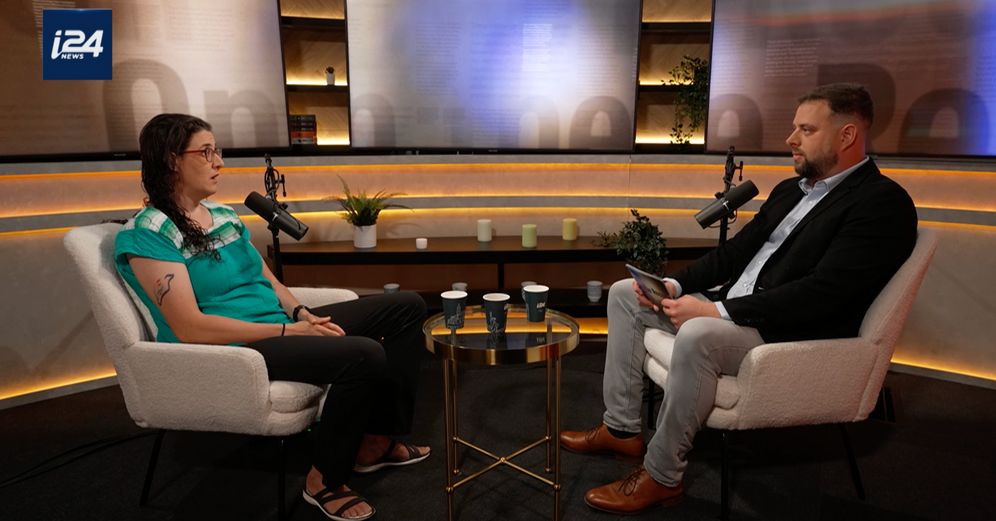
Appearing on i24NEWS’ On the Record with Ariel Oseran, Middle East researcher Elizabeth Tsurkov gave a gripping broadcast interview reflecting on her 903 days in captivity and providing a rare, firsthand look into the inner workings of the Iranian-backed proxies currently tearing Iraq apart.
Tsurkov, a Princeton University doctoral student and fellow at the New Lines Institute for Strategy and Policy, was released in September 2025 after being abducted in Baghdad in March 2023. She was held hostage for nearly two and a half years by Kata'ib Hezbollah, a US-designated terrorist organization and prominent Iranian proxy.
Returning to the airwaves not just as a survivor but as a leading analyst, Tsurkov detailed how the grueling experience of her captivity ultimately provided her with an unprecedented window into her captors' worldviews.
"I learned a great deal, I think, because of this kind of unique, obviously horrible situation, which I'm spending a lot of time with them, engaging in conversation, particularly during the initial period of interrogations and torture, and kind of understanding their worldview," Tsurkov told Oseran.
While she observed that pervasive conspiracy theories, such as the belief that the United States and Israel created ISIS, are widely accepted among the rank-and-file, her face-to-face interactions revealed that the vast majority of these fighters are fueled by financial survival rather than religious or ideological zeal. Tsurkov noted that the largest influx of recruits occurred after 2017, once the dangerous frontline fighting against ISIS had concluded and steady, state-funded salaries became available.
"What does that tell you about these individuals?" Tsurkov asked. "They're driven by material gain. Now, there are people who are ideological within these militias, but they are, from my experience and interaction with people, they're really a minority." She added that many top commanders have become multimillionaires and billionaires through systemic corruption. "These are people who enjoy life, who didn't steal all of this money to then become martyrs. They proclaim, 'oh, yeah, yeah, yeah, we're holy warriors'... No, they're thieves. At the end of the day, they want to live, and they want to make money."
Reflecting on the broader geopolitical landscape, Tsurkov emphasized that Iraq was uniquely impacted during the recent 40-day war with Iran, serving as the only territory where both sides actively exchanged strikes. She warned that the militias consistently enact Tehran’s agenda at the direct expense of their own country, going so far as to bomb Iraqi oil fields and hotels to drive up global oil prices for Iran's benefit.
Tsurkov expressed deep skepticism regarding recent claims by the newly elected Iraqi government of Prime Minister Ali Zaidi that a militia disarmament process is running smoothly. She pointed out that the three most powerful factions closest to Iran, including her former captors, Kata'ib Hezbollah, have flatly refused to play along. Because these groups lack domestic parliamentary power, surrendering their weapons means a total loss of authority.
"Without dealing with these militias, even if the other militias genuinely merge into Iraqi security forces in a way that is verifiable and truly dissolves these militias, we are not going to solve the militia problem," Tsurkov warned, noting that the open border with Iran makes any current disarmament easily reversible.
Though Baghdad is trying to align more closely with the United States to curry favor with the Trump administration, Tsurkov concluded that the Iraqi state lacks the cards to forcefully confront these groups. In her view, the militias will only disarm if the US administration presents a credible, proactive threat of military force that goes beyond standard, reactive self-defense.