1,300-year-old lead Menorah pendant unearthed near Temple Mount
During the Byzantine era, Jews were formally forbidden from entering Jerusalem. The presence of such an object suggests that Jews nevertheless continued to visit under unofficial circumstances


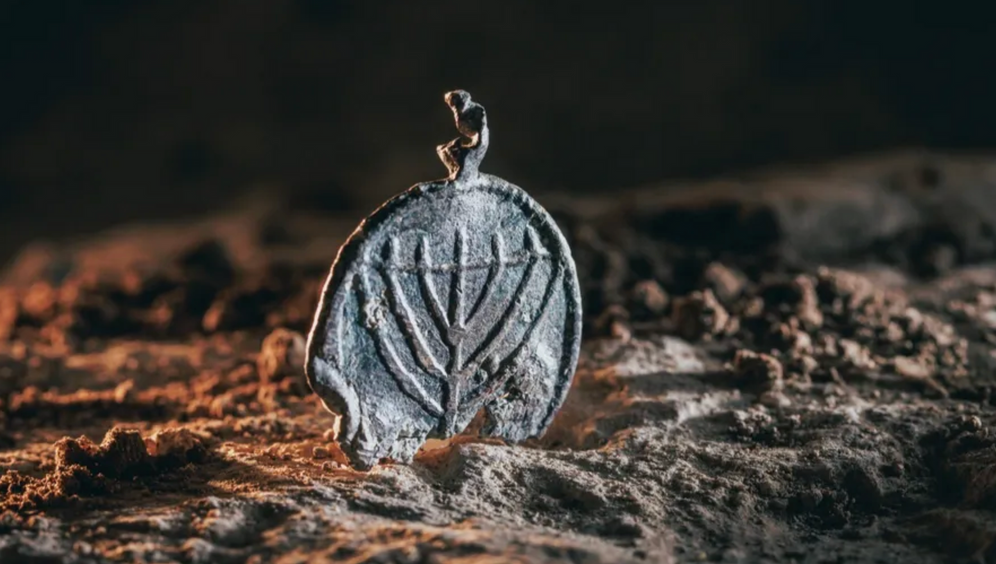
Israeli archaeologists have uncovered an exceptionally rare 1,300-year-old lead pendant decorated with a seven-branched menorah during excavations beneath the southwestern corner of the Temple Mount, north of the City of David.
The discovery sheds new light on Jewish presence and identity in Jerusalem during the Late Byzantine period, a time when Jews were officially barred from entering the city.
The pendant was found in the Davidson Archaeological Park as part of a large-scale excavation led by the Israel Antiquities Authority (IAA), in cooperation with the City of David Foundation and the Company for the Restoration and Development of the Jewish Quarter.
Dating to the 6th–early 7th centuries CE, the artifact is believed to be a personal necklace worn by a Jewish individual who made their way to Jerusalem despite imperial prohibitions.
Only one other ancient lead pendant bearing a menorah symbol is known worldwide. That artifact, of unknown provenance, is housed at the Walters Art Museum in Baltimore, making the Jerusalem find extraordinarily rare.
“I suddenly noticed something different—gray among the stones,” recalled Ayayu Belete, a City of David excavation worker who uncovered the pendant. “When I picked it up, I saw the menorah. I immediately understood it was something special. I was deeply moved.”
The pendant was discovered within rubble inside a Late Byzantine building that was later buried under an approximately eight-meter-thick layer of fill. This fill was deposited during large-scale construction works associated with the Umayyad period in the early 8th century, which sealed and preserved the earlier structures beneath it.
Cast in the shape of a disk with a loop for suspension, the pendant depicts an identical seven-branched menorah on both sides, framed by a circular border. One side is well preserved, while the other bears a natural patina.
Scientific testing using X-ray fluorescence (XRF) revealed the object to be composed of roughly 99% pure lead.
According to IAA researchers Dr. Yuval Baruch, Dr. Filip Vukosavović, Esther Rakow-Mellet and Dr. Shulamit Terem, the pendant’s material and design are highly unusual. “We are familiar with menorah depictions on glass and various metals,” they said, “but a pure lead pendant bearing this symbol is virtually unparalleled. The double depiction of the menorah underscores its deep symbolic importance and its enduring connection to the memory of the Temple, long after its destruction.”
The find raises compelling historical questions. During the Byzantine era, Jews were formally forbidden from entering Jerusalem. The presence of such a deeply personal Jewish object suggests that Jews nevertheless continued to visit and reside in the city under unofficial circumstances.
Dr. Baruch, who has directed excavations at the site for nearly 25 years, described the pendant as more than decorative jewelry. “This object is a personal emblem of memory and identity,” he said. “The choice of lead, a material commonly used for amulets at the time, suggests it was worn for protection or spiritual significance rather than ornamentation. It reflects a profound personal and national connection to Jerusalem and expresses hope for renewal and restoration.”
He added that growing archaeological evidence indicates Jews persisted in reaching Jerusalem despite restrictions, and that some may have maintained a continuous presence there.
Israeli Minister of Heritage Rabbi Amichai Eliyahu said the discovery adds to a growing body of evidence attesting to Jewish continuity in Jerusalem. “Even in periods when Jews were forbidden from entering the city, the bond to this holy place never ceased,” he said. “This pendant is a powerful testimony to devotion, memory and perseverance.”
The rare menorah pendant will be displayed to the public for the first time during Hanukkah as part of Heritage Week events. It will be featured in family tours and activities at the Jay and Jeanie Schottenstein National Campus for the Archaeology of Israel in Jerusalem. Further details are available through the Israel Antiquities Authority.