The Babylonian destruction: Archaeologists discover charred beams from First Temple Period elite building
The find comes just days before Tisha B'Av, the annual fast commemorating the destruction of the First and Second Temples in Jerusalem

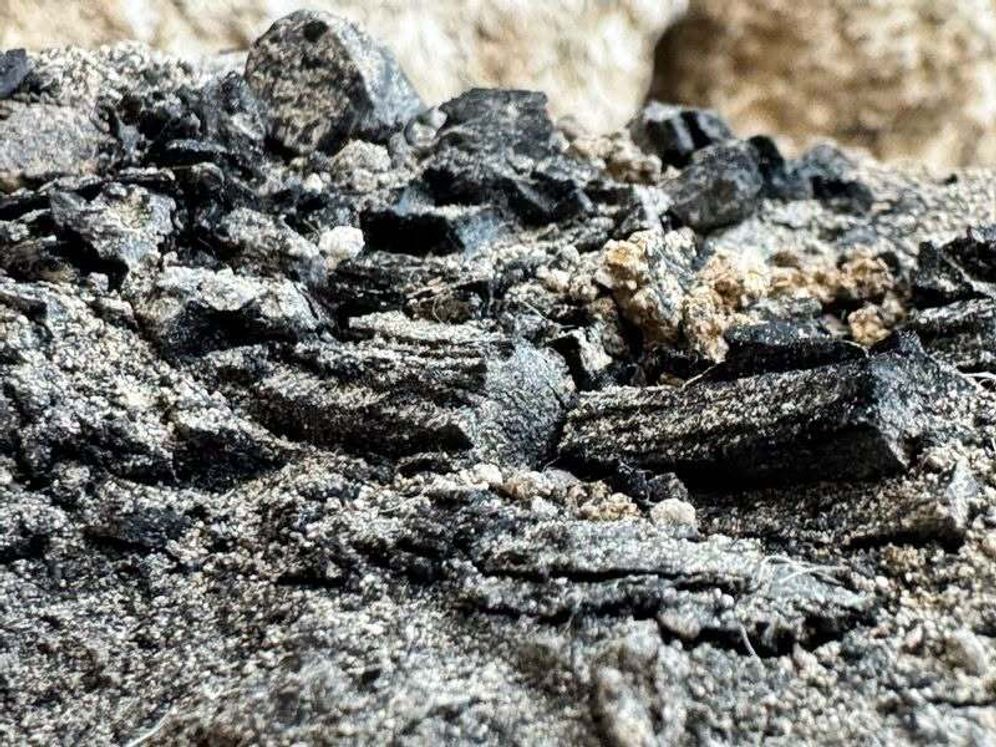
The Israel Antiquities Authority announced Monday the discovery of charred wooden beams believed to have burned during the destruction of the First Temple in 586 BCE. The sycamore beams were unearthed as part of an excavation of the Giv’ati parking lot in Jerusalem, conducted by the IAA and Tel Aviv University.
The destruction is located in a newly exposed room within a building that archaeologists have been digging in since 2018. Researchers believe the beams served as the roof of an inner courtyard in an elite building from the First Temple period, illuminating in all its characteristics the richness of the city during the 7th century BCE.
Excavation co-director Efrat Bocher said the beams likely collapsed onto the floor during the Temple's destruction and were sealed beneath melted plaster from the building's walls, which preserved them for roughly 2,600 years. "We are just before Tisha B'Av," Bocher said. "This discovery makes you feel that you are witnessing the very moment of destruction, the moment when it all happened. It's deeply moving."
Tisha B'Av, considered the saddest day of the Jewish calendar, remembers the destruction of both the First Temple, destroyed by the Babylonians under Nebuchadnezzar II, and the Second Temple, destroyed by the Romans in 70 CE, traditionally said to have occurred on the same date centuries apart.
IAA radiocarbon dating expert Johanna Regev, who is studying the find, said wood recovered from the destruction layer exhibits an unusually high number of growth rings, which is a very rare find in Israel. "Until now, we could date finds within a range of hundreds of years," Regev said. "Now we can attain much greater precision, narrowing the dating range down to as little as 10 years."
Head of the Institute of Archaeology at Tel Aviv University and Co-director Yuval Gadot illustrated this by explaining, “Remember that each ring in the wood represents a year of growth. We can take a sample from each ring (year) and document the amount of C14. This way we can learn about specific years and how the amount of C14 fluctuated,” he says. “It’s a high-resolution study.”
Suggested articles
- New exhibit offers first public glimpse of ancient Huqoq synagogue mosaics | i24NEWS, Henry Kirshner
- A mysterious tunnel discovered near Jerusalem | i24NEWS
- US returns two smuggled ancient coins to Israel after joint trafficking probe | i24NEWS, Henry Kirshner
But Gadot says it’s not so much the rings that help date the structure, but rather the date of the destruction that helps establish the date of the rings. Textual sources, which pin the date of the destruction of Jerusalem to 586 BCE, coupled with over a century of archaeological finds (material culture) allow archaeologists to “use this accumulated knowledge in order to advance the science of C14 dating.”
Dr. Yiftah Shalev, who directs the excavation on behalf of the IAA alongside Prof. Gadot, said returning Israelites likely made a deliberate decision to leave the charred remains intact to preserve the memory of the destruction. "Preserving memory is a human need, seeking to preserve what once existed... Here we see it in its clearest form, a deliberate choice to leave ruins in place as a testament to the destruction and build the new layer over them," Shalev said.
The current excavation at Giv’ati started nearly a decade ago in 2017, with excavators slowly exposing more and more of the city at the beginning of the 6th century BCE.