'US-Israel alliance is at a crossroads': Democratic Presidential hopeful speaks in Tel Aviv
Rahm Emanuel, whose family has longstanding ties to Israel, said he came to Tel Aviv to deliver what he described as an honest message from a friend


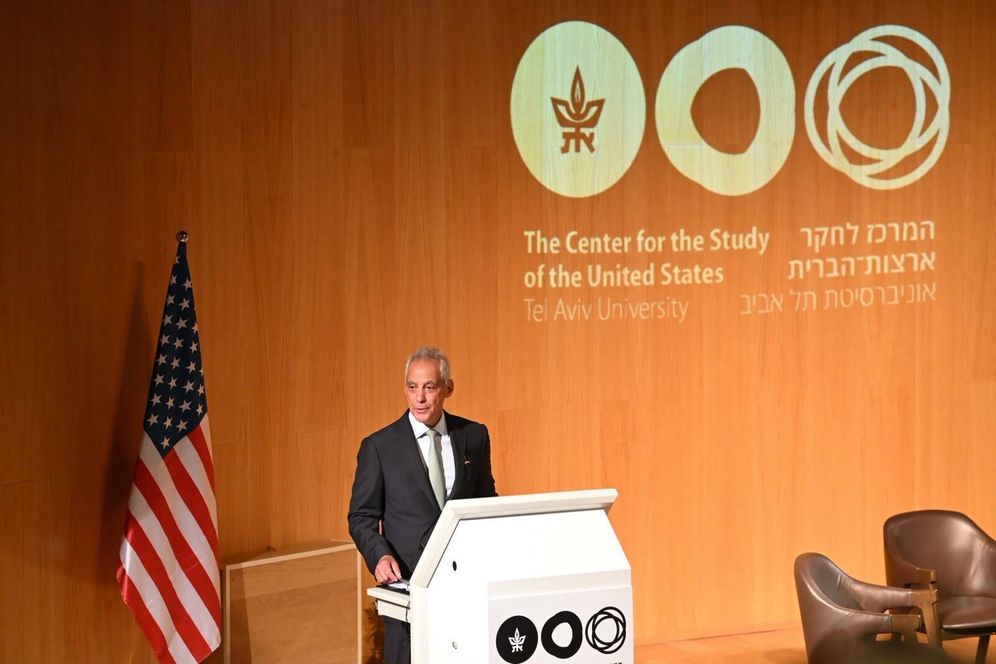
Rahm Emanuel, the former White House chief of staff and a leading Democrat widely viewed as a potential 2028 presidential candidate, delivered a speech at Tel Aviv University on Wednesday warning that Israel's alliance with the United States is at a critical juncture.
While acknowledging the deep skepticism many Israelis feel after decades of failed peace efforts, repeated wars and the October 7 Hamas attack, Emanuel argued that Israel risks undermining its strategic partnership with Washington unless it changes course on the Palestinians.
"I want to start by saying four words that Israelis don't hear often anymore: I understand your cynicism," Emanuel said. "I understand why, even if you oppose the Netanyahu government, you're so prone to dismiss criticism from the outside world."
He said he understood that Palestinians had repeatedly rejected Israeli peace proposals and that Israelis had endured waves of violence after previous attempts at negotiations.
"Three times since the early 1990s, you have offered the Palestinians sovereignty in exchange for your security—and three times your offer was not only rejected, but you were attacked as a direct consequence," he said, adding that the trauma of Hamas' October 7 attack had only deepened those fears.
"But even while acknowledging that history," Emanuel continued, "the path forward cannot be shackled to a past defined exclusively by, and consumed by, recriminations."
The former Chicago mayor, whose family has longstanding ties to Israel, said he came to Tel Aviv to deliver what he described as an honest message from a friend.
https://x.com/i/web/status/2075123583999734071
This post can't be displayed because social networks cookies have been deactivated. You can activate them by clicking .
"Without question, the alliance is at a crossroads," he said. "It cannot stand or survive as it has been. To maintain the strength of our ties, we need significant changes and a new direction."
Emanuel argued that unconditional US backing has allowed Netanyahu's government to ignore Washington's concerns over settlement expansion, the war in Gaza and regional policy.
"For too long, American policy toward Israel operated under the assumption that the best thing Washington could do for Jerusalem was to blindly and silently stand behind your government," he said. "That has been our mistake."
He said settlement expansion, settler violence in the occupied West Bank and restrictions on humanitarian aid to Gaza had contributed to Israel's growing diplomatic isolation and declining public support in the United States, particularly among younger Americans.
Issuing one of the strongest warnings of his speech, Emanuel said the United States would not support any Israeli effort to annex the occupied West Bank.
"Israel will be alone if its leaders choose to attempt to annex the West Bank and pursue the fantasies of a greater Israel," he said. "America will not, America cannot, and it will not be complicit or complacent in that endeavour."
He also criticized what he called the pursuit of a "Greater Israel," saying it was "as self-destructive and fanatical" as calls for "from the river to the sea."
Emanuel argued that Israel's military victories against Hamas, Hezbollah and Iran-backed groups had not translated into long-term strategic gains.
"Strategic isolation is not a foundation for security," he said. "It's a countdown clock."
He proposed replacing the traditional two-state framework with what he called a "23-state solution," under which Arab countries would take a leading role in helping establish a reformed Palestinian governing authority while moving toward full normalization with Israel. In return, he said, Israel would halt unilateral actions in the West Bank that undermine prospects for peace.
Emanuel also called for sanctions against Israelis involved in attacks on Palestinians or support for illegal settlements and proposed ending direct U.S. military financing for Israel while maintaining its qualitative military edge through arms sales under the same terms applied to other American allies.
Despite his criticism, Emanuel repeatedly emphasized his personal ties to Israel, recalling that his father fought in Israel's War of Independence and that he had worked on past US-led peace efforts.
"The most important thing a true friend can do is tell the truth even when it's painful," he said.