WATCH: Bennett interrupts Netanyahu’s Knesset toast: 'What about the Qatari advisers?'
The exchanges punctuated a speech in which Netanyahu renewed his call for a national unity government, citing threats from Iran and the prospect of international pressure on Israel

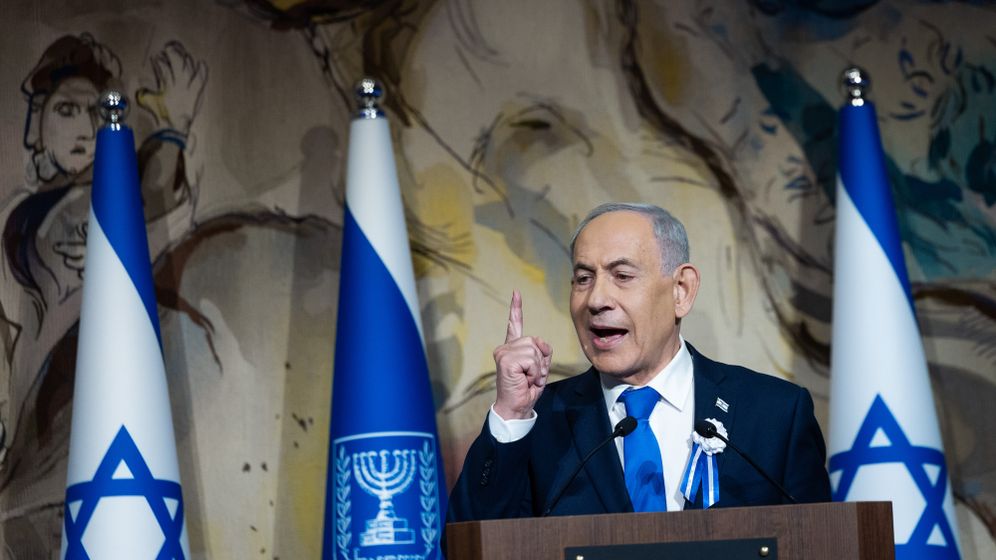
Naftali Bennett, the head of B'Yachad party, interrupted Israeli Prime Minister Netanyahu’s address to the newly sworn-in 26th Knesset on Tuesday, demanding an investigation into October 7 as Netanyahu called for a probe into alleged foreign interference in Israel’s election.
“Mr. Prime Minister, what about the investigation into October 7th? Speak about that,” Bennett called out after Netanyahu demanded a thorough investigation into suspicions that foreign entities had used large sums of money to influence the election results.
Netanyahu called for legal restrictions on that investigation to be lifted. National Security Minister Itamar Ben-Gvir responded to Bennett: “With whom do you intend to conduct this investigation—with your friend, Mansour Abbas?”
Bennett also challenged Netanyahu over allegations involving advisers to the prime minister and Qatar. “Advisors who received salaries from Qatar during wartime—what about them? Is that acceptable to you? Why don’t you declare Qatar an enemy?” he demanded.
https://x.com/i/web/status/2120202177222181210
This post can't be displayed because social networks cookies have been deactivated. You can activate them by clicking .
The exchanges punctuated a speech in which Netanyahu renewed his call for a national unity government, citing threats from Iran and the prospect of international pressure on Israel.
Netanyahu said Iran was seeking to rebuild its nuclear program despite Israeli strikes. “The only way to permanently eliminate this existential threat is to overthrow the regime of the ayatollahs,” he said.
He warned that Israel could face pressure to accept a nuclear-armed Iran and relinquish military gains in Gaza, Lebanon and the West Bank.
“We must set aside all other considerations and form a national unity government. That is the only way to overcome these considerable challenges,” he said, drawing applause from some lawmakers.
Netanyahu sharply rejected the prospect of a government led by Gadi Eisenkot that would rely on support from Arab parties.
“A government that depends, in any way, on Ra’am or the Joint List must not be formed here,” he said.
He alleged that, despite their ideological differences, both parties opposed Israel’s existence as a Jewish state. He also accused some Arab lawmakers of portraying Hamas as a charitable organization rather than a terrorist group.
The remarks drew further protests. Yair Golan left the chamber, while Gilad Kariv accused Netanyahu of incitement and said a unity government could not be formed under his leadership.
Netanyahu also appealed directly to the ultra-Orthodox parties, whose support Eisenkot’s camp is seeking to secure a parliamentary majority. He warned that their interests would be abandoned if they joined a government led by his opponents.
“Our shared mission is to resolve the status of yeshiva students and pass a conscription law based on broad consensus, in cooperation with your spiritual leaders,” he said, reaffirming his commitment to the alliance as negotiations over the next government continue.