22-hour surgical marathon: Israeli doctors rebuild a man's face, giving him a second chance
Doctors removed an aggressive tumor that had spread into the skull before rebuilding the patient's face in a rare, two-stage operation lasting more than 22 hours

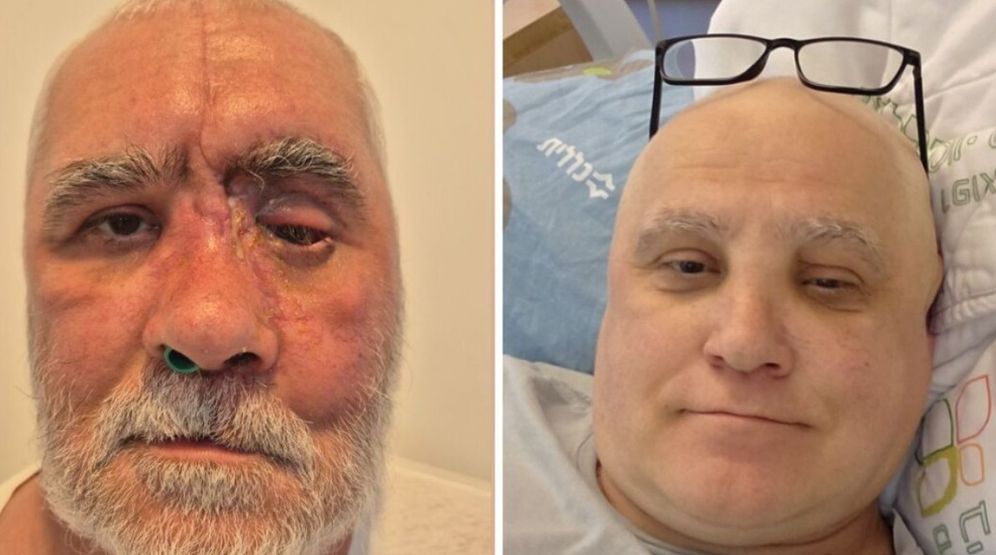
What began as persistent tearing from one eye ended in one of the most demanding reconstructive cancer surgeries ever performed in Israel.
A team of surgeons at Beilinson Hospital spent more than 22 hours across two operations removing an aggressive head and neck cancer that had spread into a patient's skull and brain lining before rebuilding much of his face using his own bone and tissue.
The patient, 50-year-old Roman from northern Israel, had exhausted conventional treatment options after chemotherapy failed to stop a rare adenoid cystic carcinoma from advancing toward his brain. By that stage, surgeons say, the tumor had invaded the eye socket, facial bones, skull base and dura—the protective membrane surrounding the brain.
With the cancer continuing to progress, doctors faced a single remaining path.
"This type of cancer offers very few effective systemic treatment options once it reaches this stage," said Dr. Noga Kurman, Head of the Head and Neck Cancer Service at the Davidoff Cancer Center. "Radical surgery became his only realistic opportunity for cure."
The operation required specialists from four surgical disciplines to work as a single team. Head and neck oncologic surgeons, neurosurgeons, maxillofacial surgeons and ophthalmologists carefully planned every stage of the procedure, balancing the need to remove every trace of cancer while preserving the patient's future quality of life.
The first operation focused entirely on eliminating the disease.
Over the course of 12 hours, surgeons removed the tumor along with sections of the frontal bone, nasal bones, cheekbones, the complete eye socket and part of the membrane protecting the brain. Rather than immediately rebuilding the face, the team waited nearly two weeks for final pathology results to confirm that the cancer had been completely removed.
Only then did reconstruction begin.
During a second surgery lasting another 10 hours, surgeons harvested bone, muscle and blood vessels from Roman's shoulder blade and sculpted them into a new facial framework. Using microsurgical techniques, they connected tiny blood vessels from the transplanted tissue to vessels in the neck, ensuring the reconstructed bone and soft tissue would remain alive and heal during the radiation treatment that lies ahead.
Dr. Esmat Najjar, Director of Beilinson Hospital's Head and Neck Oncologic and Reconstructive Surgery Unit, said the complexity of the procedure extended far beyond removing the tumor.
"Once so much of the face has to be removed, reconstruction becomes essential," Najjar said. "Our goal was not simply to eliminate the cancer. We needed to restore the structures that protect the brain, support the eye, rebuild the facial skeleton and preserve the patient's ability to breathe, eat, speak and return to everyday life."
According to the surgical team, rebuilding the eye socket presented one of the greatest technical challenges because the supporting structures had been removed along with the tumor.
Roman's journey began with what appeared to be an ordinary symptom—constant tearing from his left eye. The diagnosis that followed revealed one of the rarest forms of head and neck cancer, originating in salivary gland tissue within the nasal cavity before spreading extensively through the skull.
For his wife, Svetlana, the decision to proceed with surgery was clear despite the enormous risks.
"We were given three choices," she said. "Continue treatments that weren't working, have this operation, or wait for him to die. Giving up was never an option for our family."
Weeks after the final surgery, Roman has returned home and is breathing, eating and drinking independently. He is expected to travel overseas in the coming weeks to receive particle beam radiation therapy, which doctors hope will destroy any remaining microscopic cancer cells and reduce the risk of recurrence.
For Svetlana, the outcome cannot be measured by appearance.
"The only thing that matters," she said, "is that he is alive."