Burned alive: Father of murdered IDF soldier urges release of autopsy reports from Oct. 7th
At a Jerusalem forensic conference, Roni Eshel’s father called for reports to be shared worldwide to reveal the scale of Hamas’s atrocities

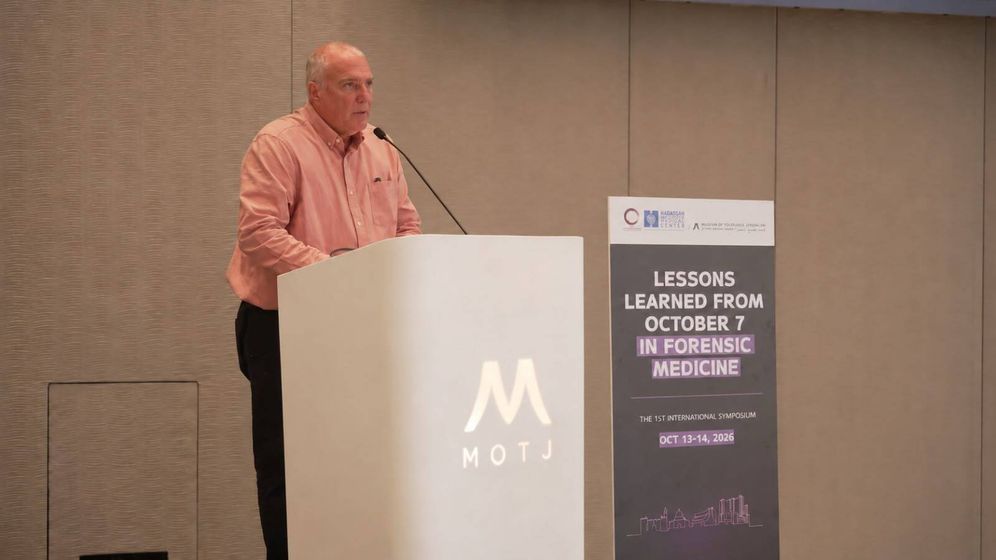
For the families of those killed on October 7, forensic identification brought an answer to an unbearable question.
At an international conference in Jerusalem on Tuesday, bereaved parents spoke about what those answers meant, and why one father believes the evidence should now reach a worldwide audience.
Eyal Eshel, whose daughter Roni was killed at the Nahal Oz military base, urged the release of autopsy reports documenting the attacks. Addressing forensic specialists at the Museum of Tolerance Jerusalem, he argued that the findings could help people abroad grasp the extent of the atrocities committed by Hamas.
"As the father of Roni—a brave surveillance soldier who defended the residents of the Gaza Envelope and IDF troops with her body and soul, and was burned alive—I call upon everyone involved in Israel’s public diplomacy regarding the October 7th atrocities: take these harrowing autopsy reports and share them with the world. The entire world needs to see and hear,” he said.
https://x.com/i/web/status/2109995116027077020
This post can't be displayed because social networks cookies have been deactivated. You can activate them by clicking .
His appeal raised a question beyond the technical work of identifying victims: how should the evidence recovered after October 7 be used to explain what happened?
For Orly Cohen, the immediate significance of that work was deeply personal. Her son Amit was murdered at the Nova music festival alongside his partner, Norelle Mansouri, and Mansouri’s sister Roya. Cohen thanked the identification teams for giving families certainty during days marked by fear, confusion and desperate hope.
Knowing what had happened, she told the specialists, gave her family a first foothold in a reality that had become almost impossible to face. She praised their sensitivity as well as their professional dedication.
The accounts from bereaved parents were accompanied by presentations showing how difficult it had been to provide those answers.
https://x.com/i/web/status/2109986592609943847
This post can't be displayed because social networks cookies have been deactivated. You can activate them by clicking .
Prof. Chen Kugel, director of Israel’s National Center of Forensic Medicine, described an operation that began before authorities had established a complete list of missing people. Teams were trying to identify victims while the scale of the disaster itself remained unclear.
Some of the material they examined consisted of burned bone fragments so fragile that they disintegrated when touched. Kugel said evidence indicated, in his assessment, that accelerants had been used deliberately to intensify fires and destroy bodies.
Dr. Nurit Bublil, from the same center, explained how exposure to temperatures above 800 degrees Celsius complicated DNA analysis. In some cases, a laboratory had just two bones to work with. Establishing an identity required advanced testing and the comparison of several sources of information.
Bublil said she interpreted the findings as evidence of preparation and systematic action.
Dental identification also faced severe obstacles. Dr. Naama Samet-Rubinstein, who volunteered at the Shura military base, described remains in which even teeth had been badly burned. Teams used CT imaging when conventional dental X-rays could not provide the information they needed.
Her presentation also addressed the handling and storage of remains, drawing lessons for future incidents involving large numbers of casualties.
Retired Brig. Gen. Yoav Telem, formerly a senior official in the Israel Police Investigations and Intelligence Division, discussed the coordination needed to build an identification and investigation operation at speed. Multiple agencies had to work together while families waited for news.
Leah Goldin, mother of the late Lt. Hadar Goldin, also spoke about the importance of certainty for relatives confronting loss and an unresolved fate.
Organized by Hadassah Medical Center with the Museum of Tolerance Jerusalem, the October 13–14 conference brings Israeli and international experts together to examine the methods developed after the attacks and strengthen responses to future mass-casualty events. Hadassah’s Dr. Ira Titunik and Prof. Esi Sharon are leading the gathering.
The families’ contributions gave those technical discussions a wider purpose: helping specialists understand what an identification means to the people waiting for it, and considering how the evidence they uncover can inform public understanding of October 7.