Why can’t Arab parties sit in Israel’s next coalition? - Analysis
“I get very upset when I hear politicians say that after October 7th, it is impossible to rely on the Arabs to form a coalition. We all experienced October 7th; Arabs and Jews alike were murdered."

“I get very upset when I hear Bennett, Lapid, or Eisenkot—or anyone else, for that matter—say that after October 7th, it is impossible to rely on the Arabs to form a coalition. And I ask: Why?”
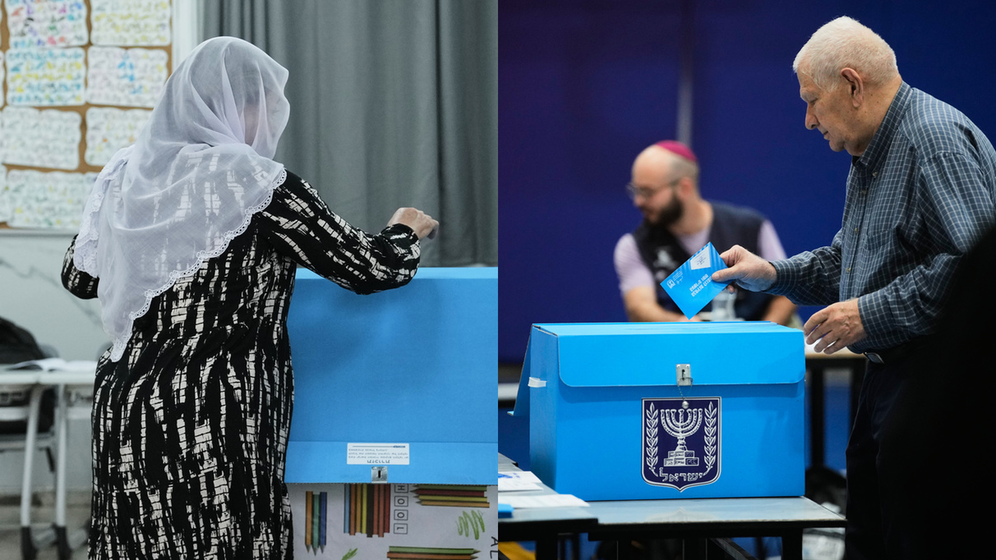
This question, raised by Arab-Israeli political analyst Mohammad Magadli in a recent podcast, is also being asked by hundreds of thousands of Israel’s Arab citizens ahead of Tuesday’s elections.
Magadli continued: “Was there a single Arab citizen who participated in the October 7th attack? The answer is no. Was there anyone among the Arab political leadership who did not come out to condemn, denounce, and express shock—stating clearly that they condemn it? We all experienced October 7th; Arabs and Jews alike were murdered, and Arabs were taken hostage—we were part of this. Furthermore, in the subsequent wars—with Hezbollah and Iran—there were both wounded and fatalities from within the Arab community.”
The top contender to replace Prime Minister Netanyahu, Gadi Eisenkot, has set three conditions for any party joining his coalition: accepting Israel as a Jewish and democratic state, the values of the Declaration of Independence, and a duty of service, military or civilian.
He has since added a fourth: the next government’s basic guidelines, he said, will state that whoever does not accept that Hamas is a terrorist organization that must be dismantled will not be a partner. “And therefore,” he concluded, “I do not see an Arab party that accepts my principles.”
The head of the Ra’am party, Mansour Abbas, has accepted Israel’s Jewish character, albeit as “a fact imposed on us.” He has also backed a voluntary, Arab-led civic service with no military ties, though he opposes the existing national-service framework. The other Arab parties have not voiced support for civilian service, so this article will not discuss the prospect of their participation in the coalition.
But Abbas has repeatedly declined to publicly call Hamas a terror organization, a decision that has raised suspicion from many Jewish voters. Earlier this month, a member of his party, Yasser Hujirat, was asked in an interview whether Hamas was a terrorist organization. “This organization—part of which is essentially a charitable organization—also has a component that seeks to gain the right to exist and the right to be recognized as a state,” was his response.
As for Abbas himself, when asked a few months ago in a radio interview about his position regarding Hamas, Abbas replied: “I have an unequivocal answer, but I won’t state it. I am constantly receiving threats from Arabs, Jews, and criminal organizations.”
Abbas added: “We have condemned every act of terror and all the crimes that took place on October 7th—not only from a civilian perspective, but also from an Islamic religious perspective… None of us should be subjected to such a loyalty test. It is the wrong approach. People constantly fall into this trap set by extremists in Israel.”
Refraining from calling Hamas a terror organization is not a good look in Israel of 2026, especially ahead of the first national elections since the October 7 massacre. But making that the ultimate test of loyalty and a prerequisite to receiving a ‘kosher stamp’ to be part of the ruling coalition ignores reality, precedent, and deep sensitivities in Israeli society.
It ignores reality because if Eisenkot’s full “Zionism test” were to be applied on some of the current coalition parties, such as the ultra-orthodox, they would fail the test. It ignores precedent as Ra’am was already part of the coalition in 2021.
It ignores the deep sensitivities in Israeli society as many of Israel’s 21% Arab population consider themselves Palestinians, others have family in Gaza and the West Bank, and others consider themselves Zionists. Some Arab families will have all these identities living under one roof.
So the test should be in action. When Ra’am was in the coalition, it did not block a single military operation. Even when it froze its membership over the 2022 Temple Mount clashes, it returned. And since then, Ra’am has announced its separation from the Islamic Movement, which has been accused of having ties to the Muslim Brotherhood.
And what do the Arabs want? According to a May poll by Tel Aviv University, 77.2% of Arab Israelis said an Arab party should join the next government, and 75.8% supported voluntary civilian national service for Arab graduates.
As for the Jewish population, a majority of opposition voters favor forming a government supported by an Arab party, if the anti-Netanyahu bloc fails to win a majority on its own.
If the only thing that has changed from the previous time an Arab party sat in the coalition was the October 7 massacre, which saw no involvement by Israel’s Arab population, sorry, but that’s not enough
So what is really keeping them out? Magadli has his own answer:
"So, where does the problem lie? This is where the whole story begins: if it had served Benjamin Netanyahu's political interest—in terms of forming a government—to portray the Arabs as the heroes of this war, I can tell you that they would have become heroes. Those who stepped up, those who took part, those who helped, and those who suffered casualties—it simply does not align with Benjamin Netanyahu's political interests."
Suggested articles
- Three residents of the Bedouin diaspora arrested for election bribery; Ra'am files complaint with CEC | i24NEWS
- President Herzog casts his vote, urges Israelis to turn out: 'This is our day to go out, make an impact, and vote' | i24NEWS
- Election Day opens with minute of silence at Hostage Square for the families of Oct. 7 victims | i24NEWS