Ancient humans may have kept souvenirs 500,000 years ago; study points to colorful stones and flint tools
The authors say souvenirs may have raised evolutionary pressure on memory mechanisms in the brain, a hypothesis and not proof. Evidence includes colorful pebbles at Qesem Cave and old flint tools

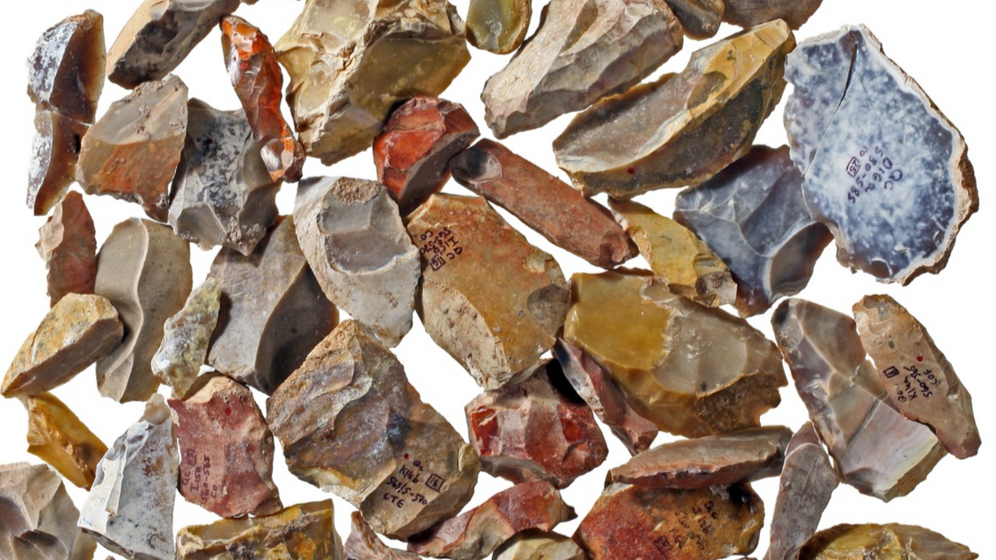
Ancient humans may have collected souvenirs as far back as half a million years ago, according to a new Tel Aviv University study that points to colorful stones, fossils, and old flint tools found at prehistoric sites in Israel. The researchers propose that such objects helped early humans remember places and events from their lives, and may have shaped the evolution of personal memory and the sense of self.
The study, published in the journal Evolutionary Anthropology, was led by Dr. Yoav Ram of the School of Zoology and Prof. Ran Barkai of the Department of Archaeology, with Prof. Liad Mudrik, Dr. Ella Assaf and Dr. Bar Efrati. It combines archaeological findings with psychology and neuroscience, pointing to objects that ancient people collected, carried and kept although no clear practical use was found for them.
The authors suggest they may be personal souvenirs.
“It is clear to everyone that memory played a central role in the lives of our ancestors in the distant past, but until now, no possible evidence for this had been successfully found,” Barkai said.
At Qesem Cave, small colorful pebbles were found that had been brought from other places, with no practical use identified. In the Sakhnin Valley, handaxes were shaped from flint nodules containing fossils or unusual geological forms, preserved at the center of the stone where they can be seen and touched.
At Revadim, Jaljulia, and Qesem Cave, old flint tools were collected after their surfaces had changed over time, and some were resharpened while most of the old surface was kept. The researchers raise the possibility that the old look was itself valuable to those who kept the tools, because it told the story of the object.
The researchers estimate that an object brought from a certain place could have triggered a memory of a personal event, and that its look and feel may have helped its owner tell an experienced event from a story heard or imagined.
Because a souvenir is private and can be carried and shown to others, it may also have strengthened the credibility of a personal story. Reliable personal memory, the study notes, can contribute to cooperation and trust.
Over many generations, the researchers suggest, the use of souvenirs may have increased evolutionary pressure on brain mechanisms responsible for the origin and reliability of memory. Material culture and biological evolution thus influenced each other, contributing to the development of autobiographical memory, the ability to organize personal experiences into a continuous life story on which the sense of self rests.
Barkai linked the habit to changes in the environment, in particular the disappearance of large animals, most notably elephants, on which humans depended. “The need to focus on hunting grounds inhabited by medium-sized animals led to a fundamental change in the operational mode of early humans and may have driven new needs expressed through the collection and creation of objects carrying the meaning of memory and the development of self-identity,” he said.
To put it succinctly, Dr. Ram stated, “When ancient people brought a colorful stone or an old tool they found in the field into a cave, that object may have helped them remember a significant event or meeting for the rest of their lives"
Suggested articles
- Egyptian authorities remove murals of famed Pharaohs over dark features, promoting "Afrocentric" narrative | i24NEWS
- Ancient soap workshop uncovered beneath Jerusalem's Old City reveals centuries-old industry | Henry Kirshner
- Bringing the Bible back: i24NEWS travels to the Elah Valley to uncover the ancient Judean fortress of Azekah | i24NEWS, Henry Kirshner