Judeo-Arabic culture of Tunisian Jews presented in an intimate exhibit
This new exhibition in Beer Sheba, by the artist Eliahou Eric Bokobza, explores the rich heritage of the Jewish community in Tunisia

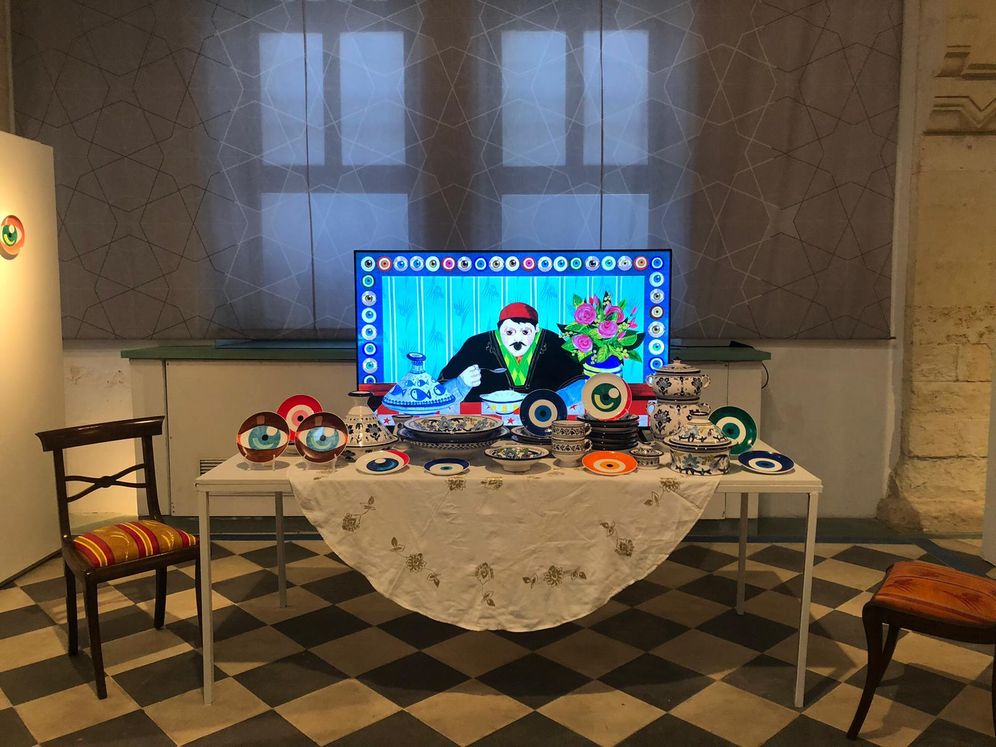
Eliahou Eric Bokobza's new exhibition "Family Affair" presents the culture and customs of Tunisian Jews in the 19th and 20th centuries in a unique and intimate way, with paintings in the colors of Tunisia, as well as jewelry, period silverware, video animations, holographic projections, Judeo-Arabic music and traditional dress.
Inaugurated on September 20 at the Museum of Islamic Culture and the Near East, in the southern city of Beer Sheba in Israel, and in partnership with the Institut Français. Through the prism of art, Tunisia, France and Zionism intertwine.
The fascinating exhibition plunges visitors into the Judeo-Arabic world and gives the Sephardic diaspora of Tunisia the place it deserves in Israel, in a society where the reputation given to the "mizrahi" is often flawed.
Visitors enter room by room into the reconstructed home of the artist's parents, who left Tunisia for Paris before immigrating to Israel in 1969. Presented as an exploration of the daily life in a typical Jewish family in Tunis, punctuated by traditions.
In search of identity
Bokobza arrived in Israel at the age of 6 and inherited the Judeo-Arabic culture of his Tunisian Jewish parents, while integrating smoothly into Israeli society. Over the past two years, he has drawn inspiration from this heritage to create works depicting the multiple nationalities and strong sense of identity he wishes to convey.
"This exhibition is in fact a reflection on my first exhibition 'Oriental Pleasure' in 2000. My art is a kind of inspection of all facets of my identity. I was born in Paris, but I'm not French; I'm the son of Tunisian immigrants who settled in Israel. I define myself as Israeli, Jewish, of French culture and North African descent," Bokobza told i24NEWS.
"The exhibition was born out of a 'discomfort' with the term mizrahi. In Hebrew, the definition is racist and does not include any nuance between Sephardic Jews, whereas in reality we are quite different. Moreover, in Israeli society, there is a refusal to admit that the culture of the Jews who lived in Arab countries is imbued with the culture of Islam, and this is what I wanted to show here. I also wanted to bring to light another facet of Tunisian culture that is not sufficiently emphasized in Israeli society, and to evoke the fact that racism stems from ignorance, so we have to start by learning the history of the Jews of Tunisia,” he continued.
"The blending of French, Judeo-Zionist and Arab-Muslim culture is a concept that already existed in my grandparents' home, and I've materialized it with a representation of a woman's tombstone where French, Hebrew and Arabic cohabit," Eliahou Eric Bokobza.
Some of the objects, pottery, jewelry and clothing were collected directly from the Tunisian Jewish community in Israel for the exhibition, which opens with a Tunisian passport featuring a photo of Eliahou and his mother.
Passover “Seder” festivities with animated holiday singing, the boys' festival (Itro) or traditional meals and love relationships between men and women of yesteryear are represented thanks to Bokobza's modernized period furniture and his mother's trousseau, allowing visitors to fully feel the atmosphere that reigned in their home.
"My mother passed away over 17 years ago, and I grew up knowing that she had her bridal trousseau in her drawers, complete with embroidered tablecloths and sheets in Muslim stitch, as well as jewelry. The only thing I've done to preserve this memory is to introduce it in small ways into my art,” Bokobza said, adding that in his parents' home, these objects reminiscent of Tunisian culture were an integral part of his upbringing.
"I wanted to perpetuate the bond my mother had with her objects, which she kept all her life, and somehow make them timeless,” he explained.
Reference to the evil eye
In many of Bokobza’s paintings, the eye, the palm-shaped Khamsa amulet and fish are found in large numbers. In Tunisian Jewish culture, the fear of the evil eye is very present and important. The artist has given it pride of place in a room dedicated to cooking, by multiplying the amulets to guard against the superstition that a look, praise or compliment from one person to another has the power to bring down a curse.
"There are nuances in customs among Tunisian Jews, among those originally from Tunis, it's very badly perceived to show amulets against the evil eye. Everyone fears it, but it's offensive to put a Khamsa or a blue eye at home. So I'm taking an ironic approach to this motif and bringing to light a notion that's hidden. For some people, these amulets work and are frowned upon because they have real power,” Bokobza explained.
This playful exhibition offers a real immersion into Judeo-Arabic culture and sheds light on its influence on Israeli society.
"What's special about Tunisian culture is that it preserves its identity while respecting surrounding cultures and living alongside them. Art can, I believe, help change the way people think," the artist concluded.
The vernissage will take place on September 20 at 6pm. A meeting with the artist is organized on September 23 at 10:30 a.m., moderated by Dr Sharon Laor-Sirak, curator of the exhibition, followed by a conference with Sonia Fellous, a PhD research fellow at the Institute for Research and History of Texts, CNRS-Paris, working on the "Cultural heritage of the Jews of Tunisia: an endangered legacy.” The exhibition runs until May 2024 at 60 Hatsmaout Blvd in Beer Sheba.
Caroline Haïat is a journalist for the French i24NEWS website.
Read more stories like this:
• Arab designers bring 'voice of change' to unique exhibition >>
• Unseen shots by pioneer photographers exhibited in Jerusalem >>
• Bedouin city Rahat to host 2nd International Film Festival in February >>