'We need the best weapons': India's opposition leader Rahul Gandhi defends Israel ties
Gandhi's defense of India's strategic relationship with Israel, despite his criticism of the war in Gaza, drew condemnation from left-wing parties and highlighted differences with Modi's approach.

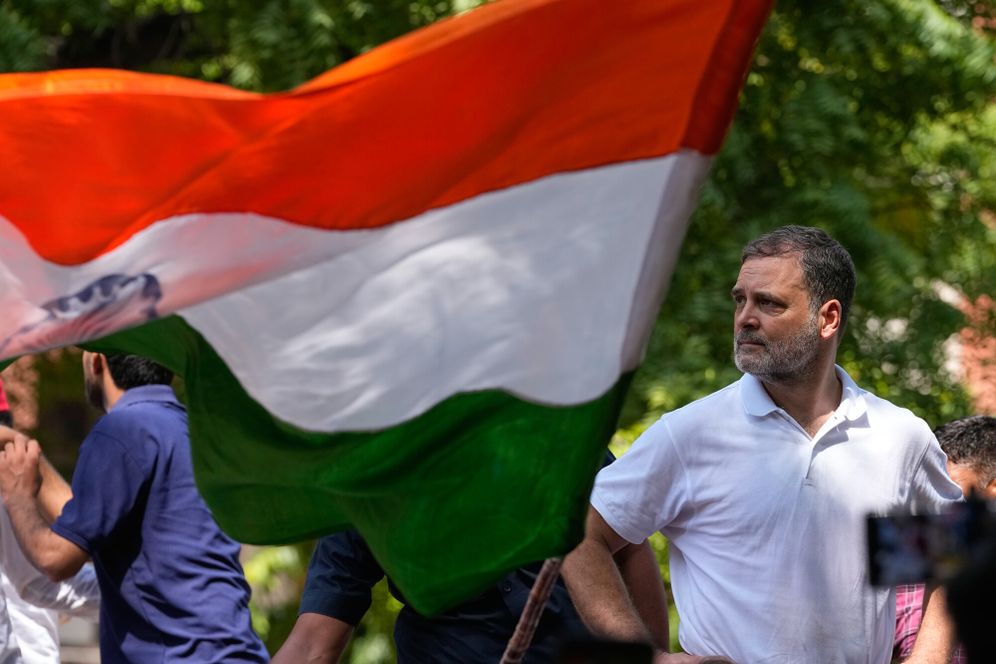
Rahul Gandhi, leader of India's opposition, defended India's relationship with Israel at a conference at the University of Chicago last week, drawing ire and condemnation from various sections of India's left wing.
Gandhi began by condemning the October 7 attacks but also Israel's actions in Gaza, saying, "Two wrongs don't make a right."
"There are strategic reasons for our relationship with Israel," he continued, saying, "We buy weapons from Israel. Frankly, we need the best weapons and they happen to produce very good weapons."
"I'm fully for that relationship, but it has to be on India's terms. Whether that's with Israel, the US, Russia, China or anybody."
In a video posted to X, Gandhi also said that India was the biggest buyer of Israeli weapons and that had to be accounted for.
https://x.com/i/web/status/2123445057466605877
This post can't be displayed because social networks cookies have been deactivated. You can activate them by clicking .
Gandhi heads the Indian National Congress (INC) in the lower house of parliament, the Lok Sabha. The Congress dominated India's post-independence politics for much of the 20th century and was traditionally more supportive of Palestine, only establishing full diplomatic relations with Israel in 1992.
This changed in the 1990s when Narendra Modi's conservative Bharatiya Janata Party (BJP) began to emerge as a rival to the Congress, finally ousting it in 2014.
Modi's rise to power ushered in a new era of closer cooperation between India and Israel, made more intense by the so-called "bromance" between Modi and Israeli Prime Minister Benjamin Netanyahu.
Gandhi's comments were condemned by various sections of the Indian left, including the Social Democratic Party of India, which accused him of betraying his great-grandfather's legacy.
"We believe that his stand blatantly contradicts the views and thoughts of Jawaharlal Nehru, who stood firmly with the anti-colonial and anti-apartheid struggles of his time. By endorsing Israel, Rahul Gandhi has not only abandoned that legacy but has also exposed a disturbing political opportunism," the party said.
Condemnations also came from the Communist Party of India (Marxist) and the Indian Union Muslim League, a parliamentary ally of the Congress.
Meanwhile, Congress researcher and analyst Amitabh Dubey had a more positive view of the comments, calling them "a thinly veiled criticism of Modi’s kowtowing to Israel." He highlighted the poor timing of Modi's last visit, which occurred just days before Israel and the US struck Iran last February.
Dubey also pointed to comments made by Israeli human rights lawyer Eitay Mack, which portrayed the trip as a "humiliation" for Modi and India, saying, "He acted and spoke like the leader of a minor state visiting a global power, desperate to curry favour."
Within the context of Indian politics, Gandhi's comments may instead appear critical of the relationship, reducing it to a mere arms purchase, a far cry from the personal and strategic relationship fostered by Netanyahu and Modi.