Afeka students take solar-powered car from Israel to Belgium, and finish their first 24-hour race
The students finished 14th out of 30 teams in their debut appearance, completing nearly 800 kilometers in a car they designed and built themselves.

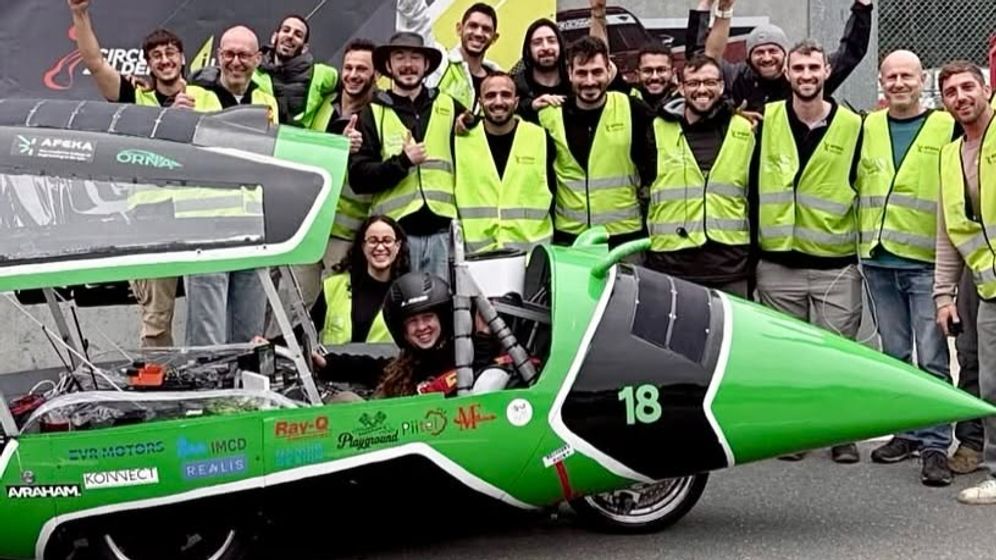
For the students of Afeka College of Engineering in Israel, a summer engineering project turned into an international racing debut.
The Afeka Racing team became the first Israeli team ever to compete in the iLumen European Solar Challenge, a 24-hour solar-powered car race held in Belgium.
And they didn't just make it to the starting line.
The students completed 197 laps — nearly 800 kilometers (500 miles) — finishing 14th out of 30 teams in their first-ever appearance.
“Wow, it was amazing, exciting, full of challenges and success,” said team leader Dan Herman after the race.
For fellow team member Ido Tager, simply finishing was an achievement in itself.
“There are teams that have done this event a couple of times already and didn't finish,” Tager said. “And we are doing it for the first time; we finished with our first car, which is insane to even think about it out loud.”
From classroom to racetrack
Before the team headed to Belgium, we visited the students at Afeka to see the car they had spent months designing and building.
The vehicle features a carbon-fiber body, with the students developing and assembling much of the technology themselves.
“This is the chassis. Everything is connected to that — the driver's seat and steering wheel, suspension and so on,” Herman explained while walking us through the car.
The car can reach speeds of around 110 kilometers per hour, but keeping it moving for 24 hours requires much more than speed.
The team had to carefully manage its battery, charging strategy, and driver changes, all while following strict competition rules governing when and how the vehicle could be charged.
And the students weren't leaving anything to chance.
They tested the car on a real racetrack in Israel and used a simulation room to familiarize themselves with the Belgian circuit before arriving at the competition.
“We wrote the speeds that we are going to need to adhere to during the race,” explained team member Amit, pointing to a simulation of the track. “Each corner has its own speed.”
The students practiced where to brake, when to lift off the accelerator, when to turn and when to accelerate — preparing for the roughly two-hour driving stints each driver would take during the 24-hour race.
Learning by doing
For the students, the project was about much more than building a solar-powered car.
It was an opportunity to experience engineering outside the classroom — with real deadlines, budgets, suppliers, mechanical problems and the pressure of competition.
“Being here and working with other students and engineers and suppliers and working with the real industry, you can't learn elsewhere,” said team member Guy. “You have to be hands-on, and you have to do it in this kind of project.”
For Maya, the motivation goes even deeper.
“I started to learn engineering because as a kid I wanted to change the world,” she said. “I want to feel like I'm doing some good things and to be part of something bigger.”
That philosophy is at the heart of the project.
Here, students can make mistakes, fix them, and try again — learning about teamwork, engineering, budgets, and perseverance by actually doing the work.
Suggested articles
- A look inside the dark web: Crime, anonymity and underground markets | Lynn Plagmeijer
- Startup bets on AI-powered robots to solve billion-dollar citrus harvesting challenge | Lynn Plagmeijer
- United Hatzalah deploys AI-powered ambulance network to predict medical emergencies | i24NEWS, Lynn Plagmeijer
And this is only the beginning
The race in Belgium may be over, but Afeka Racing isn't stopping there.
The team says the project is expected to continue, with ambitions to compete in future international events — potentially including Australia — while developing the next generation of their solar-powered vehicle.
For team member Maya, there's also a bigger message behind the project: showing what Israeli engineering students can build.
“The most important is to keep our message loud and to show the Israelis that we've got something great here,” she said. “We are doing something that is not mad science.”
And the project is already having an impact beyond the racetrack.
Herman says the hands-on experience is giving students a direct pathway into the engineering industry — and he has already begun helping some team members find jobs.
“I saw the way they are working, so I can see how they can contribute in the industry,” he said.
After 24 hours, 197 laps and nearly 800 kilometers on the track, the Afeka students have now got something else to add to their engineering education: a solar-powered racing debut on the international stage.