Israeli company MIA Dynamics bets on the future of ground robotics
As drones dominate modern warfare, Israeli mobility company MIA Dynamics is developing unmanned ground vehicles designed to transport equipment, evacuate wounded soldiers & take on dangerous missions

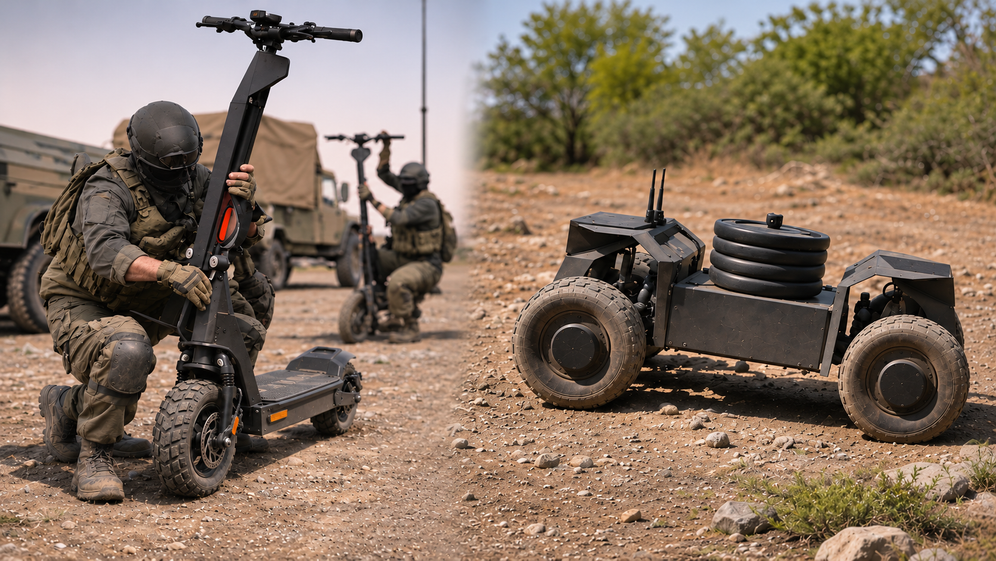
Inside a workshop in Tel Aviv, a new generation of electric vehicles is taking shape. Some look like compact four-wheelers, others are designed to operate without a driver. But they all share one central idea: combining manoeuvrability and stability to move across challenging terrain.
Founded in 2020, Israeli company MIA Dynamics initially focused on civilian mobility, developing compact four-wheeled electric vehicles that combine the stability of four wheels with the agility traditionally associated with two-wheelers.
The company's technology allows its vehicles to adapt to different types of terrain while maintaining stability, even at high speeds and with a relatively high centre of gravity, according to Yoshi Bluth, the company's vice president of sales.
But the company's direction began to change after the October 7 attacks, when military units approached MIA Dynamics to explore whether its vehicles could be adapted for battlefield use.
"They came to us and said: Can we use this for missions? Maybe just to take a payload from one point to another," said Yaniv Hebron, co-founder and chairman of MIA Dynamics. "They tried it, they loved it, and this is when we started with defense."
One of the resulting applications combines the company's MIA 4 electric vehicle with a motorised trailer capable of carrying between 150 and 200 kilograms. Equipped with its own battery and motor, the trailer can transport equipment and potentially help evacuate injured personnel across difficult terrain, reducing the need for soldiers to carry heavy loads themselves.
But the requests from military units did not stop there. MIA Dynamics began developing unmanned ground vehicles, or UGVs: remotely operated robotic platforms designed to transport different types of payloads without requiring a person onboard.
The company's UGV uses all-wheel steering and a self-balancing mechanism, allowing it to manoeuvre across challenging terrain. According to Raz Ankava, the company's robotics leader, the platform can carry payloads of approximately 150 to 200 kilograms, despite weighing less than 100 kilograms itself.
An operator can unload the robot from a vehicle or helicopter, then control it remotely using a handheld system and onboard cameras. Its potential applications range from logistics and casualty evacuation to carrying specialised equipment for military and civilian missions.
While drones have become a major focus of military investment in recent years, Hebron believes ground robotics could be the next frontier.
He predicts that investment will increasingly shift towards ground-based solutions over the next decade, with the technology behind the vehicles — particularly their ability to transport different payloads — becoming a key area of development.
And the potential applications extend beyond defense. MIA Dynamics says it has received interest from sectors including agriculture, delivery services and accessibility, with the possibility of adapting its technology to help people with disabilities improve their mobility.
For Hebron, the broader ambition is part of a global shift towards using machines in situations where human lives could be at risk.
"When you can send a robot in order to save a soldier's life, I prefer to send a robot," he said. "If the robot is cheap and effective, they're going to send a robot."
From civilian mobility to battlefield robotics, MIA Dynamics is betting that the next major development in unmanned technology won't just take place in the air — but on the ground.
Suggested articles
- From brain science to quantum computing: Israeli entrepreneurs take the stage at the Peres Center | Lynn Plagmeijer
- Chemi Peres on his father’s legacy: Why peace and innovation must go hand in hand | Lynn Plagmeijer
- Afeka students take solar-powered car from Israel to Belgium, and finish their first 24-hour race | Lynn Plagmeijer