"Neither an inevitable fate nor a private matter": Report finds 166 women murdered in Israel since 2022
Tal Hochman, CEO of the Israel Women's Network, said the findings "demand an immediate change in course"

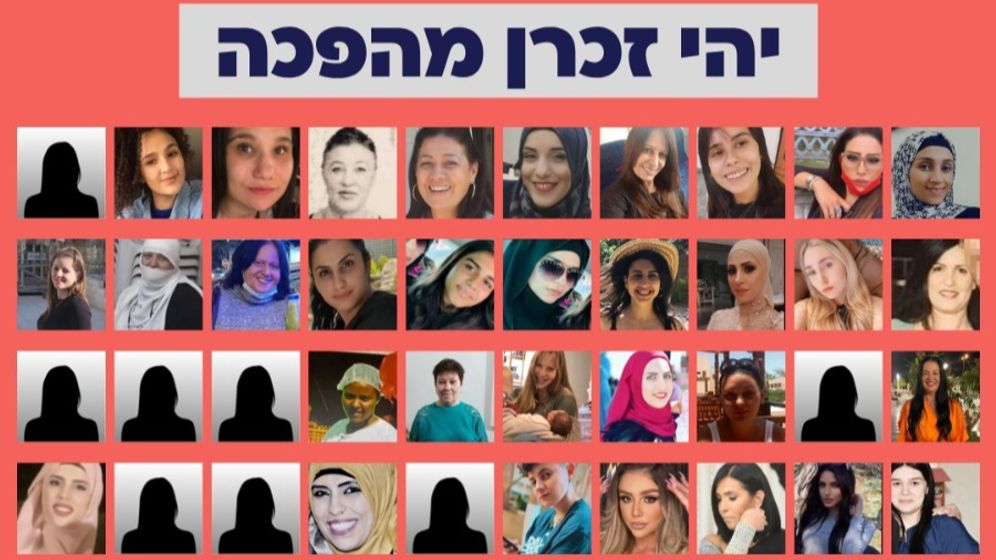
The Israel Women's Network (IWN) has released a report finding that 166 women were murdered in Israel between January 2022 and the present, 134 of them in gender-based killings. Roughly 83% of those gender-based cases took place in the context of domestic or intimate partner violence.
The report summarizes five years of monitoring and was published ahead of the International Day for the Elimination of Violence against Women.
Among its starkest findings is a gap in how often the cases are solved. A total of 91% of gender-based murders of Jewish women have been solved, compared with just 26% of those involving Arab women.
The disparity persists even within families and relationships, where 80% of killings of Jewish women were solved, against 45% for Arab women.
The report also documents a sharp rise in the use of guns.
It also identified 12 women who were killed amid conflicts between criminals or criminal organizations in which they played no part. They were allegedly targeted as a form of retaliation or to threaten someone close to them.
The IWN is urging the adoption of a unified definition of gender-based murder that would include such cases. Drawing on the 2012 Vienna Declaration on Femicide and the UN measurement framework, the group argues the definition would allow a full assessment of the problem, proper allocation of resources, and prevention policy.
"Five years of painstaking data collection demonstrate, time and again, what the State refuses to acknowledge: gender-based violence is neither an inevitable fate nor a private matter," declared Tal Hochman, CEO of the IWN. "The responsibility for preventing the killing of women and ensuring personal safety lies with the State," Hochman said, calling for systematic data collection, a national policy, dedicated budgets and "concrete measures that will save lives."
Behind the figures are individual stories
To illustrate its findings, the IWN highlighted the stories of four women killed in recent years. Their cases reflect the patterns the report describes: investigations that stall, protection orders that go unenforced, and women caught up in violence that had nothing to do with them.
Johara Khanifs, 28, from Shefa-Amr, campaigned against violence toward women. She was killed in June 2022 by an explosive device attached to her vehicle.
About 2,000 people attended her funeral, demanding an end to the violence. Her case remains unsolved.
Maya Cohen, 49, from Hadera, was murdered in April 2025. According to the report, her brother, who is accused of the killing, was already known to welfare authorities and police for previous violence and threats against her.
He had repeatedly breached protection orders and was violating one on the day she died. Her body was found buried in the yard of her home.
Lin Mugrabi, 24, from Ramla, the mother of a two-month-old, died in September 2024 when a grenade was hurled into a shop. The explosion also claimed the lives of the shop assistant and two children.
Mugrabi is suspected to have been the intended target over a dispute linked to her marriage to the son of a crime syndicate leader.
Marina Malinovsky, 32, a victim of prostitution and human trafficking, came to Israel from Ukraine during the COVID-19 pandemic and at times slept on the street. In March 2024, she was staying with an acquaintance in Tel Aviv against whom she had filed three police complaints over threats, physical violence, and sexual assault. He allegedly raped her and beat her to death before dumping her body, wrapped in a sheet, on the street near his home.
For the IWN, these deaths show the human cost behind the statistics, and the gaps the State has yet to close.