Meet B'Yachad's lineup: Who’s who in the 26th Knesset
Who’s who on B'Yachad's list? Meet the people behind the names, explore their backgrounds, and discover their paths to the 26th Knesset

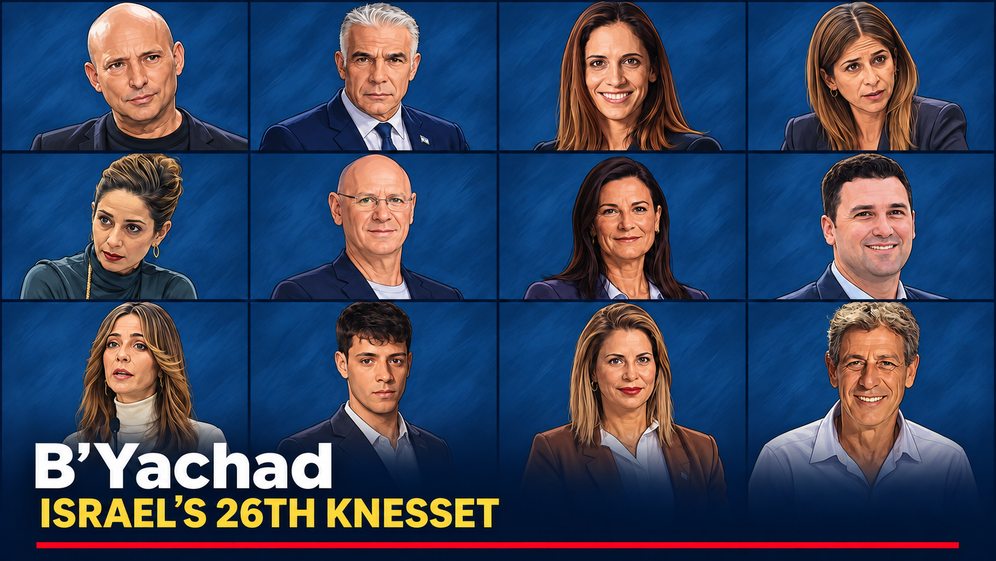
Israel’s 26th Knesset is set to be sworn in on Tuesday, bringing 120 new and returning members of Knesset into the chamber after October’s election. It is a class that mixes political heavyweights with first-time parliamentarians: 47 of the incoming MKs have never served in the Knesset before, while 55 were not members of the outgoing parliament.
The incoming Knesset reflects an unusually broad cross-section of Israeli public life. Alongside longtime party leaders and former ministers, it includes business figures, religious educators, community activists, former security officials and newcomers from across the country’s political and social spectrum.
Thirty-three of the 120 MKs are women, and the class ranges from veteran politicians returning to the Knesset after years away to first-timers who won a seat on their first national run. Among the returnees is Eli Goldschmidt, who left the Knesset 25 years ago as a Labor MK and is now returning as a Likud representative.
Benjamin Netanyahu's Likud remains the largest single party, with 27 seats, followed by Gadi Eisenkot’s Yashar with 21 and Naftali Bennett’s Beyachad with 12. The Joint List won 11 seats, while The Democrats and Ra’am each took eight; Yisrael Beiteinu, United Torah Judaism and Otzma Yehudit won seven apiece, and Shas and Religious Zionism six each.
The arithmetic leaves no bloc with a majority: Netanyahu’s right-religious bloc holds 53 seats, Eisenkot’s opposition bloc 48, and Arab-led parties the remaining 19, making the incoming Knesset one of the most fragmented in recent memory. Gadi Eisenkot was awarded the first mandate by Israeli President Isaac Herzog, and now has just under a month to form a government out of the aforementioned parties.
Two political paths, one shared ticket. Formed in 2026, B'yahad—Hebrew for “together” brings Naftali Bennett’s Bennett 2026 party and Yair Lapid’s Yesh Atid under one electoral banner, reuniting two former prime ministers. Behind that partnership are politicians with distinct backgrounds, priorities and visions for Israel’s future. In this installment of our Knesset profile series, we meet the people behind the alliance- and explore what brings them together and where they stand.
Read more from i24NEWS’ profile series on the parties of the 26th Knesset >> Click here
Naftali Bennett — No. 1
Naftali Bennett began his career in Israel’s high-tech sector, co-founding Cyota, a cybersecurity company later sold for $145 million, and serving in senior technology and business roles.
He entered politics initially as Benjamin Netanyahu's chief of staff from 2006 to 2008, and was the director of the Yesha Council, the council of Israeli settlements in the West Bank.
He entered parliament in 2013 with the Jewish Home party, later founded the New Right and led Yamina. He became defence minister in 2019, then led the “change government” from 2021 as prime minister under a rotation agreement with Yair Lapid. His coalition united ideologically diverse factions, but defections from his own party contributed to its collapse and early elections. He did not stand in the 2022 elections, but returned to unite with Lapid's centrist Yesh Atid in 2026.
Bennett was born in 1972 in Haifa and lives in Ra’anana. He served in Sayeret Matkal and the Maglan unit, is married to Gilat and has four children. His parents moved to Israel from San Francisco 5 years before he was born.
Yair Lapid — No. 2
Yair Lapid built his career in journalism and television. He worked for Maariv, edited Yediot Tel Aviv and wrote a weekly column for 19 years. He presented several talk shows on Channel 2, including 'Yair Lapid' and 'Studio Friday'. and published 12 books.
He entered politics in 2012, founding the Yesh Atid party. After the 2013 election he became finance minister and later served as opposition leader. In 2021, he was given the mandate to form a government, and agreed on a rotation role as prime minister with Naftali Bennett, allowing Bennett to serve first. He was foreign minister during this time. After Bennett's resignation in 2022, he became prime minister until his electoral defeat in the 2022 elections. He is the shortest serving prime minister in Israel's history, at 181 days.
Born in Tel Aviv in 1963 to journalist-politician Tommy Lapid and author Shulamit Lapid, he is married to journalist Lihi Lapid and has three children, one of whom has autism. He lives in Tel Aviv.
Keren Terner Eyal — No. 3
Keren Terner Eyal built her career in public administration and infrastructure. After leaving the IDF as a captain from the Moran unit, she joined the Finance Ministry in 2004, working on transport, interior and foreign-workers policy.
She served as a director at Israel Post and Israel Railways, then became deputy director-general for infrastructure and transport coordination at the Transport Ministry. In 2016 she was appointed director-general by Israel Katz, helping deliver the Jerusalem–Tel Aviv fast rail, Dan light rail, public-transport lanes and the ports reform.
Born in 1979, Turner is divorced with three children. She holds bachelor’s and master’s degrees in economics, business administration and management from the Hebrew University.
Meirav Ben-Ari — No. 4
Meirav Ben-Ari began her public career after winning the reality show “A Leader Is Needed,” using the platform, and 5 million shekels prize, to establish youth centers in Netanya and Herzliya.
She entered municipal politics by serving on Tel Aviv's city counncil and holding the youth-advancement portfolio from 2013 to 2015. She then joined Moshe Kahlon’s Kulanu and entered the Knesset in 2015. She later joined Yesh Atid, returning to the Knesset in 2021 and chairing the Internal Security Committee.
Born in 1975, Ben-Ari lives in Tel Aviv and has a daughter. A former Golani education officer, she is a lawyer with an MBA from Reichman University, where she chaired the student association.
Liron Avishar Ben-Horin — No. 5
Liron Avishar Ben-Horin began her career in law and public diplomacy. She spent four years in the United States as the Reform movement’s first immigration emissary and head of the Jewish Agency’s aliyah delegation in North America.
She was an advisor to Eyal Gabay, director-general at the Prime Minister’s Office, and served as chief of staff for his successor, Harel Locker. In 2013 she became CEO of the Jewish Agency’s Masa project.
She became director-general of the Communications Ministry in 2020 under Yoaz Hendel, advancing fiber-optic and broadcasting legislation, and later led cross-sector partnerships at the Tkuma Directorate.
Born in 1976 and raised in Migdal HaEmek, Ben-Hurin is married with two children. A former IDF officers’ course commander, she holds degrees from Tel Aviv University and NYU.
Noam Tibon — No. 6
Noam Tibon spent more than three decades in the IDF, beginning in Sayeret Matkal in 1981 and fighting in the First Lebanon War. He returned to the army in 1987 and built a decorated career, retiring in 2015 as a major general and commander of the Northern Corps.
After leaving the military, he chaired Tel Aviv’s “Ir Olam” volunteer initiative, worked as a military commentator and managed hi-tech company Trax Systems from 2016 to 2020. He later founded the “Protective Wall for Israel” forum during the protests against the judicial overhaul and campaigns for equality in the burden of service. On October 7, Tibon travelled from Tel Aviv to Nahal Oz to rescue his son, journalist Amir Tibon, and helped rescue survivors of the Nova festival attack.
Born in 1962, Tibon lives in Tel Aviv with his wife, author Dr Gali Mir-Tibon, and their two sons. He holds degrees from the University of Haifa and Harvard.
Michal Hirsch Negri — No. 7
Michal Hirsch Negri built her career in education and municipal leadership. An educator by training, she managed schools in Herzliya, Kfar Saba and Tzur Yigal before becoming deputy director-general and head of the education administration at Ra’anana municipality in 2006.
In 2013 she became CEO of the Ra’anana municipality, serving until 2019 and becoming the first woman to hold the post. She later co-founded EDU NOW with former education minister Shai Piron, providing consulting and support in education, society and community.
After her son Roy was killed defending Be’eri on October 7, Nagari became a leading voice among bereaved families opposing the draft-exemption law. She is a member of the “Enlisting for Unity” forum and advocates universal meaningful service as central to national resilience.
Born in 1966, Negri is married with two daughters. She holds a bachelor’s degree in English education and a master’s with honors in education administration from Bar-Ilan University.
Eitan Ginzburg — No. 8
Eitan Ginzburg began his career in local politics, winning a seat on Ra’anana’s city council in 2003. He later chaired the city’s water utility, Mei Ra’anana, and became mayor in 2018, becoming its first openly gay mayor, serving until the end of that year.
He entered national politics with Benny Gantz’s Blue and White Party in 2019 and represented them in the Knesset until 2022, when he narrowly missed out election, being 14th on Gantz's National Unity list that garnered 12 seats. He returned to the Knesset in 2025 after the resignation of Gadi Eisenkot. He was briefly communications minister in 2021, and held senior Knesset roles including deputy speaker.
Born in Argentina in 1977 and raised in Ra’anana, Ginzburg has twins with his partner Yotam, born via surrogacy. A former Military Police officer and active reservist lieutenant colonel, he holds law and government degrees from Reichman University and a master’s in political science from Tel Aviv University.
Meirav Cohen — No. 9
Meirav Cohen began her career in media and public advocacy. After serving on Army Radio and as the Prime Minister’s Office’s socio-economic spokesperson under Ariel Sharon, she founded a headquarters to combat fraudulent telemarketing firms that exploited elderly people and stripped them of savings. She later led the Public Trust organisation and founded CrowdAction, a startup helping consumers harmed by corporate wrongdoing join together to pursue their rights.
She served on the Jerusalem city council before joining Yesh Atid. Elected to the Knesset in 2019, she became social equality minister in the “change government” and now chairs the Special Committee for Holocaust Survivors.
Born in 1983, Cohen is married to Yuval Edmon and has three children. She holds degrees in economics, business administration and urban planning from the Hebrew University.
Yonatan Shalev — No. 10
Yonatan Shalev is the youngest candidate on Beyachad’s list and, at 24 years and 29 days old, he will become the youngest ever member of the Knesset. Born in Baltimore in 2003, he immigrated to Israel at 12, attended the Rabin pre-military academy and served in the IDF’s Maglan unit.
In 2024 he founded the “Shoulder to Shoulder” movement, part of the campaign for equality in the burden of service during the Swords of Iron war. The movement represents fighters and reservists and advocates an enlistment or civilian-service framework for all sectors, while opposing laws preserving draft exemptions
Shalev is the son of Prof Eran Shalev, a historian at the University of Haifa, and Michal Tzur Shalev, a high-tech entrepreneur who co-founded Cyota with Naftali Bennett. He lives in Zichron Yaakov.
Bruria Naim Arman — No. 11
Bruria Naim Arman began her career in senior public-sector roles, serving as adviser and chief of staff to transport minister Ephraim Sneh and chief of staff to the deputy defence minister. She later became deputy CEO for community relations at mass-transit company NTA.
She founded CR Community Relations, which advises on transport, energy, urban renewal and infrastructure. After October 7, she established and managed the Hostages Families’ Headquarters’ field operation until March 2024. She also serves on the board of Shamru Nafsham, which supports people coping with PTSD, and is CEO of the Beyachad party, managing its field operations
Na’aman is married with three sons and holds bachelor’s and master’s degrees in politics and political science from Bar-Ilan University.
Ram Ben-Barak — No. 12
Ram Ben-Barak built his career in Israel’s intelligence community. After serving as a fighter and officer in Sayeret Matkal, he joined the Mossad, rising to deputy head of the organisation. He later served as director-general of the Intelligence and Strategic Affairs Ministries from 2014 to 2016, after a period coordinating special operations for the IDF.
He joined Yesh Atid ahead of the 2019 election and has served in the Knesset since. He ran against Yair Lapid for the party leadership in 2024, losing by a narrower margin than expected.
Born in 1958, Ben-Barak lives in Moshav Nahalal with his wife Ayelet, a physician at Rambam Health Care Campus, and their three children. He holds a master’s in political science and national security from the University of Haifa.
Want to know who else will be in the 26th Knesset?: