Meet Joint List's lineup: Who’s who in the 26th Knesset
Who’s who in the Joint List party? Meet the people behind the names, explore their backgrounds, and discover their paths to the 26th Knesset

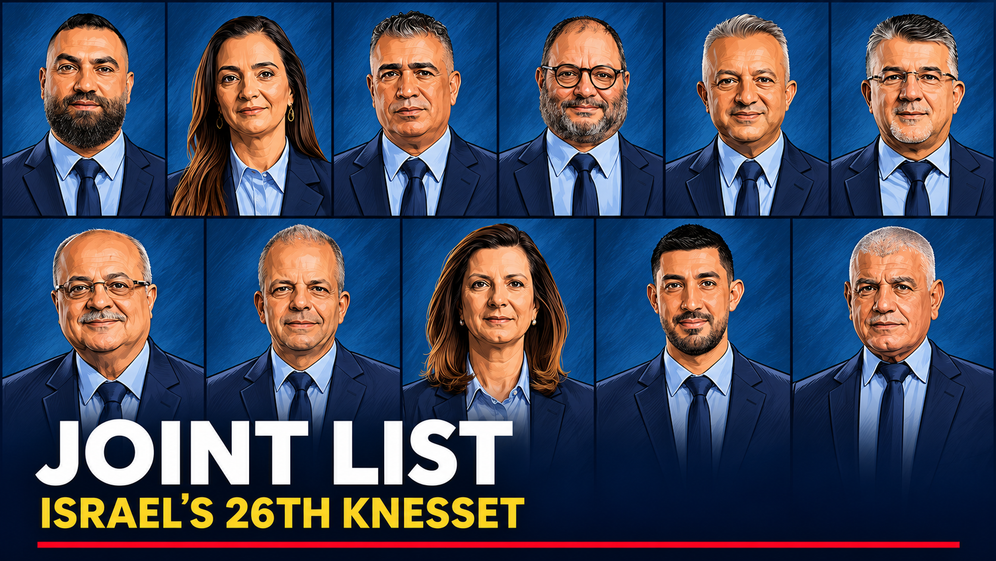
Israel’s 26th Knesset is set to be sworn in on Tuesday, bringing 120 new and returning members of Knesset into the chamber after October’s election. It is a class that mixes political heavyweights with first-time parliamentarians: 47 of the incoming MKs have never served in the Knesset before, while 55 were not members of the outgoing parliament.
The incoming Knesset reflects an unusually broad cross-section of Israeli public life. Alongside longtime party leaders and former ministers, it includes business figures, religious educators, community activists, former security officials and newcomers from across the country’s political and social spectrum. Thirty-three of the 120 MKs are women, and the class ranges from veteran politicians returning to the Knesset after years away to first-timers who won a seat on their first national run. Among the returnees is Eli Goldschmidt, who left the Knesset 25 years ago as a Labor MK and is now returning as a Likud representative.
Benjamin Netanyahu's Likud remains the largest single party, with 27 seats, followed by Gadi Eisenkot’s Yashar with 21 and Naftali Bennett’s Beyachad with 12. The Joint List won 11 seats, while The Democrats and Ra’am each took eight; Yisrael Beiteinu, United Torah Judaism and Otzma Yehudit won seven apiece, and Shas and Religious Zionism six each.
The arithmetic leaves no bloc with a majority: Netanyahu’s right-religious bloc holds 53 seats, Eisenkot’s opposition bloc 48, and Arab-led parties the remaining 19, making the incoming Knesset one of the most fragmented in recent memory. Gadi Eisenkot was awarded the first mandate by Israeli President Isaac Herzog, and now has just under a month to form a government out of the aforementioned parties.
A shared banner with a history of differences, the Joint List first brought four parties together ahead of the 2015 election to strengthen Arab representation in the Knesset.
Today, the alliance unites Hadash, Ta’al and Balad, bringing distinct political traditions and priorities to the same ticket. In this installment of our Knesset profile series, we meet the people behind the partnership- their backgrounds, their ambitions and their visions for Israel’s future.
Read more from i24NEWS’ profile series on the parties of the 26th Knesset >> Click here
Youssef Jabareen — No. 1
Youssef Jabareen built his career in law, academia and civil society. A lawyer and graduate of the New Israel Fund’s human-rights fellowship, he lectured in law and human rights at the University of Haifa and headed the social-education hub at Tel-Hai College. He founded and led Dirasat, an Arab centre for law and policy, and co-directed the Clinic for Arab-Palestinian Minority Rights at Haifa. He also served on the board of Sikkuy, which promotes Jewish-Arab equality.
Elected to the Knesset in 2015, Jabareen has represented Hadash and the Joint List, chaired the Special Committee for the Rights of the Child and now leads the Joint List. Born in Umm al-Fahm in 1972, Jabareen is married with four children and lives in his hometown. He holds a doctorate in law, a master’s from the American University in Washington and a PhD from Georgetown University.
Ahmad Tibi — No. 2
Ahmad Tibi began his career as a doctor, graduating with honours in medicine from the Hebrew University in 1983 and interning in gynaecology at Hadassah Mount Scopus. He was fired from Hadassah Hospital in 1987 after an altercation with an American-born security guard.
After the Oslo Accords, he became Yasser Arafat’s advisor on Israeli affairs and later as the spokesperson for the Palestinian delegation at the Wye River summit. He founded Ta’al in 1995, entered the Knesset in 1999 and has served continuously since then. A veteran of Arab politics in Israel, Tibi has chaired the Public Health Lobby, served as deputy speaker and focused on health, budgets and services for Arab local authorities.
Born in Tayibe in 1958, Tibi still lives there and is married with two daughters. He is the brother-in-law of former MK Osama Saadi.
Faten Ghattas — No. 3
Faten Ghattas has spent nearly three decades in public health and community work. Since 1997, he has directed the Israel Cancer Association’s activity in Arab society, leading public education, smoking prevention and early cancer-detection campaigns.
His work focuses on making medical information and services more accessible to the Arab public. He has also served on the National Council for Health Promotion.
Ghattas lives in Rama and holds a master’s in philosophy from Hebrew University and a doctorate in political science from Sofia University in Bulgaria. When studying in Bulgaria, he became leader of its chapter of ‘Maki’, the Israeli communist party.
Bakr Awawda — No. 4
Bakr Awawda built his career in public policy, education and civil society. He directed the Galilee Society for Health Research and Services and the Center Against Racism, and later worked in consulting and local-authority development.
A longtime Balad activist and member of its leadership, he focuses on Palestinian national identity among Arab citizens of Israel, civil and national equality, and expanding Arab political representation. In June 2026 he was elected second on Balad’s list, behind party chair Sami Abu Shehadeh. After Abu Shehadeh’s disqualification, he became the highest ranking Balad MK in the Joint List.
Awawda is from Kafr Kanna, where he serves on the local council. He holds two master’s degrees, in public policy and education-system management.
Ofer Cassif — No. 5
Ofer Cassif is an academic and political activist who has taught government, politics and public administration at the Hebrew University, Tel Aviv-Yafo Academic College and Sapir College. He holds a PhD in political philosophy from the London School of Economics and completed a postdoctoral at Columbia University.
Drawn to socialist ideas from youth, he served in a Nahal garin and became the first refusenik to refuse service in the Palestinian territories during the First Intifada, for which he was imprisoned. He later worked as parliamentary aide to Meir Vilner, secretary-general of Maki. In 2019, Cassif was elected to the Knesset on Hadash’s list, becoming the party’s only Jewish MK.
Born in Rishon LeZion in 1964, Cassif lives in Rehovot and is married with one child.
Youssef Atauna — No. 6
Youssef Atauna built his career in education and local government. After training at the Kaye Teacher Training College in Be’er Sheva, he worked as a teacher, then led the youth division at the Bnei Shimon Regional Council and later the education department at the Hura local council.
He entered politics through Hadash, running unsuccessfully in several elections. In 2017, after resignations from the Joint List, he was appointed an MK and served for 15 weeks.
Born in 1966, Atauna lives in Hura in the Negev and is married to two wives, despite polygamy being banned in Israel, and has three children. He holds a bachelor’s in education and a master’s in administration and public policy from Ben-Gurion University.
Maha Karkabi Sabbah — No. 7
Maha Karkabi-Sabbah is an Arab-Israeli sociologist, researcher and educator. A lecturer at Ben Gurion University, Hebrew teacher and group facilitator, her work focuses on education, Jewish-Arab relations, women’s advancement and social gaps.
She began political activity in 1994 in Hadash’s student branch at the University of Haifa, later joining the secretariat of its Arara branch. In June 2026 she was elected third on Balad’s list, behind Sami Abu Shehadeh and Bakr Awawda. She said that as an MK, she intends to prioritise public education, at-risk youth and violence prevention in Arab society.
Ahmad Darawshe — No. 8
Ahmad Daraoushe began in student activism before moving into political staff work. He served as adviser and chief of staff to MK Ahmad Tibi, and later as a member of Ta’al’s central committee.
He also served on the Iksal local council and as CEO of the Reineh local council, gaining experience in municipal management and local governance.
Daraoushe is a lawyer and businessman from Kafr Qara. In the 2024 local elections he led a united local list that won two seats on the city council. He currently lives in Reineh, is married and has one child.
Nihaya Washahi — No. 9
Nahaya Washahi built her career in education and community work. Active in Rahat’s public and municipal arenas, she served as deputy mayor for the Al-Wusta list after the 2018 local elections.
She has a bachelor’s degree in education from the University of Haifa, a master’s and a doctorate in education administration from Jedara University and Al-Yarmouk University, both in Jordan. She worked with at-risk youth in Arab-Israeli society. She has been a lecturer at Al-Qasimi College and Oranim College.
She lives in Arava in the Negev, and is married with two children.
Hassan Nassasra — No. 10
Hassan Al-Nasasra spent about three decades in education, working as a teacher and principal, including managing the Abu Obeida school in Rahat. He also chaired Balad’s faction in the Teachers Union.
He later moved into municipal politics, serving as deputy mayor of Rahat for the Al-Wusta list after the 2018 local elections. He is a well known political figure in the Bedouin community
Haitham Zahalka — No. 11
Haitham Zahalka built his career in law, business and local politics. A lawyer and businessman from Kafr Qara, he served as deputy mayor for two terms and sat on the Wadi Ara planning and building committee.
He is a member of Ta’al’s central committee and focuses on economic development, strengthening local authorities, combating violence and expanding opportunities for young people. Zahalka is also among the founders of the Hagar association, which established bilingual educational frameworks in Be’er Sheva.
He is married with one child and lives in Kafr Qara.
Want to know who else will be in the 26th Knesset?: